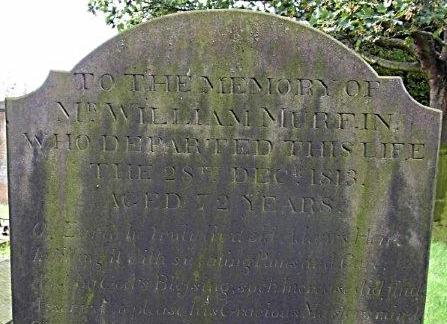
 By chance I found the headstone on William Murfin’s grave at St Nicholas, Chiswick. I had already discovered his will, but it threw up a question to which the inscription on this headstone provides the answer.
William Murfin (1741-1813) was head gardener at Chiswick House by 1790 and worked for Georgiana, Duchess of Devonshire, on her Ladies Garden and Pleasure Garden. Trained by Robert Teesdale Senr at Castle Howard, he was recommended for the Chiswick post by the Duke of Portland’s gardener at Welbeck. Murfin’s name appears as witness to the will of a fellow servant in the Devonshire household, Mary Griffiths, in August 1797. He left his Chiswick House post in the winter of 1811/12 when his salary was listed as £60. His name is crossed out in the accounts, with ‘Robert Clues’ written in above – he was to receive £100 a year. By the time of his death at 72, in December 1813, William Murfin had retired to Turnham Green.
His tomb stone carries this verse:
On Earth he truly liv’d old Adam’s heir,
In tilling it with sweating Pains and Care:
And by God’s blessing such increase did find
As served to please his Gracious Master’s mind,
Till from those Earthly gardens he did Rise
Transplanted to the upper Paradise
William Murfin still described himself as ‘gardener’ when he wrote his will in 1813. He was prosperous enough to make bequests involving over £3,200-worth of Bank of England stock which included:
• income and dividends from Bank of England Stock to his good friend Ann Venables of Turnham Green, spinster, for her natural life
• £300 capital stock to his sister Eleanor and her husband William Poyser
• £300 capital stock to his sister Joice, widow of George Clews
• £100 capital stock to his niece Elizabeth Horne, wife of William, carpenter of Whetstone, Middlesex
• £500 to William Murfin, son of my cousin William Murfin, of Bradley, Derbyshire, grocer
• £50 capital stock for her own use to Mrs Anne Allnutt, wife of William Allnutt, of Piccadilly, Middlesex, turner and
• £2,000 of capital stock transferred to cousin William Murfin the elder
The will confirms that his family came from parishes on the Staffordshire/Derbyshire border. Our William’s father was almost certainly the William born in 1716 in Bradley, Derbyshire, whose wife was Ellen; William Murfin the elder died on 5 August 1792 and was buried in Doveridge, also in Derbyshire. His two sisters married local farmers – Eleanor’s husband was William Poyser of Swincoat in Blore, Staffs and Joice married George Clews of Marchington, Staffs.
The Chiswick William Murfin makes no mention of a wife or children in his will, though a John Murfin was buried at St Nicholas in July 1791, around the time that William came to work in Chiswick. (There are only three mentions of the surname in the registers). However, he may have had a son also called William Murfin; the parish registers of St Cuthbert’s, Ackworth, just south of Wakefield, record the baptism of a son of that name to William Murfin, gardener and his wife Sarah, at Low Town, in 1772.
William’s Clews nephews
William bequeathed his ‘stock’ (mentioned separately from Bank of England stock) to his two Clews nephews. Since both were gardeners this must refer to garden stock at Turnham Green where he might have been running a nursery after his retirement from the Chiswick House estate. In his will William describes his nephew Robert Clews as “gardener to his Grace the Duke of Devonshire at Chiswick” and Robert’s brother, Thomas, as “gardener to Rt Hon Lord Bradford at Weston Hall, Staffs”. Robert had taken over from William Murfin at Chiswick on Lady Day 1812 at £100 a year. In addition to the garden stock the nephews were to have the residue; Robert was one of three executors along with William Allnutt and Richard Williams (of the Chiswick Nursery).
 The will of Robert Murfin, our William’s brother, suggests that he had a hand in training the next generation. Robert Murfin was gardener at Saltram in Devon; he was ill and died shortly after making his will in August 1798. The owner of the Saltram estate bemoaned his loss in a letter to to a friend, wondering how she was going to replace him. He made his brother his executor and left him the residue of his estate. His main bequest was £600 in 5% bank stock to his three sisters. He left £50 to one of the garden workers, £20 to a godson and £10 to his nephew Robert Clews, ‘labourer at Saltram’, who was working alongside him.
No record has been found of a marriage involving Thomas Clews at Chiswick. However, the parish registers record the baptism on 13 March 1808 of a baby boy born on 9 January 1808. The entry names him as Thomas Clues Murphin, the son of Thomas Clues and Martha Kerrison, and he may have been illegitimate. Perhaps the addition of the second surname of Murfin indicates that William had taken his nephew’s child under his wing. No further record of Thomas Clews Murfin occurs in the Chiswick registers and he is not mentioned in William’s will. A Thomas Clews, farmer, aged 55, is listed in the 1841 Census at Weston Mill Farm near Weston Hall with his wife and three children; perhaps he had become a farmer in his own right after gardening at Weston Hall.
No marriage or burial record has been traced for Robert Clews. However, he has nevertheless left us a significant legacy for as head gardener he must have overseen the major works on the former Morton Hall estate to the east of Burlington’s garden, acquired by the 6th Duke of Devonshire in 1812 – these created the Italian Garden and the long conservatory with gardeners’ bothies behind, and took in the walled gardens to the north. The scale of the works can be judged by a report in The Morning Chronicle on 19 November 1812 which stated that 150 men had been employed in the gardens for the previous six months. He played a part in the Horticultural Society’s gardens (the predecessor of RHS Wisley today) which lay just north of the Chiswick House estate and was made a Fellow of the Society, a sign that he was held in some esteem by his peers. In 1823 he exhibited there a number of varieties of grapes and in 1830 two varieties of apple named after him. He also appeared in the 1830 subscription list to support the Horticultural Society’s garden, contributing five shillings.
Resolving the puzzle
The question posed by William Murfin’s will is who was his ‘good friend’, Ann Venables? Only one other Venables appears in the parish registers at this period; a ‘Robert Venable’ was buried at St Nicholas in January 1779 but there is no evidence that he was related to her. Ann’s will reveals more. There she described herself as ‘spinster’ of Turnham Green, whereas Murfin had called her ‘spinster and servant maid’. The Chatsworth Servants’ Database reveals that she was the Housekeeper, a very senior “servantmaid” indeed, from at least 1774. Her request in the will to be buried in the same grave as her late friend Mr William Murfin raised the second question – was this carried out? She died, aged 72, in December 1814 and we know that her request was fulfilled because her executors added an inscription to William’s headstone which confirms that they were together. They were most probably a couple but unmarried.
Ann left specific furniture and silverware as well as the residue and the funds in the Bank of England to William Murfin’s nephews. As well as a selection of silver cutlery, Robert was to have the white bed furniture and bedding in the white bedroom, a bureau with drawers, chairs and a washstand. Thomas Clews received Anne’s own bedroom furniture, including a mahogany wardrobe, and she left her gold watch to Thomas’s wife. The home sounds as if it is furnished with some taste. Ann did not specify the post of Thomas Clews, but referred to Robert as the Duke of Devonshire’s gardener. Robert was to be one of her executors along with William Allnutt.
According to the will and insurance records Allnutt was a wood turner at 186 Piccadilly. He lived to be over 90 and appears in the 1841 census, next door to the Blackmore family in Stamford Brook (in the north-east corner of Chiswick Parish). Susannah Blackmore and Ann Robarts (living in the house left to them by their father William Blackmore) were also beneficiaries – amongst Ann’s bequests to them was a leather trunk with the initials GR, possibly originally from the royal household. William Murfin had been a witness to the will of their father, William Blackmore, proved in 1799.One other gardener in this circle knew the Blackmores well. Robert Teesdale jnr, who died at Christmas 1804, had lived in Turnham Green since the early 1790s. Two of the witnesses to his will were Susannah Blackmore and her sister Ann.
Some of Ann Venables’ own relatives and neighbours are also mentioned. Ann left money, elegant garments and china ornaments from her bedroom mantelpiece to her cousin, the wife of a vicar in Bengeo in Hertfordshire. Her best clothing was to go to Esther Allnutt, wife of William, one of her executors, and her ‘worst clothing’ was to go to her servant along with £5. The presence of a servant for a woman only recently described as a servant maid herself says something of her status.
So William may have been widowed by the time he came to Chiswick House, certainly had a close relationship with Ann Venables, who was buried with him, and lived in some comfort. He seems to have continued gardening after his nephew took over from him at Chiswick, and had close friends at Turnham Green and Stamford Brook. The links to different estates in England for this one gardening family alone, show how experienced garden specialists were recruited by land owners and moved from one end of the country to the other.
Sources of information
• Chatsworth archives, ms L114/51, Household Establishments No 2, Chiswick Establishment, 25 December 1811. Information from Peter Hammond, 22.05.2014
• Will of Robert Teesdale 1740-1804, PROB 11/1420; described as ‘of Hammersmith’ in will, he lived at Turnham Green in Chiswick Parish by 1790, with his wife Britannia and 3 sons
• Details of early career from David Jacques’ research on Chiswick House gardens, 1980s
• Will of William Murfin TNA PROB 11/1551
• Robert Clews’ grapes, reported in Journal of Science and the Arts vol 15 1823 and apples reported in J C Loudon Gardeners Magazine vol 6 1830
• Will of Robert Murfin, TNA PROB 11/1312
• Will of Ann Venables TNA PROB 11/1579
• Will of William Blackmore TNA PROB 11/1319
• Robert Teesdale’s will, PROB 11/1420
• Letter from Anne Robinson of Saltram, 30 August 1798 PWDRO 1259/2/399
• Bill from Robert Murfin for trees and garden work at Saltram, 1791-3, PWDRO 1259/5/22


