presenting the inventive nursery gardeners of Brentford, Chiswick and nearby Middlesex Parishes, 1650-1850
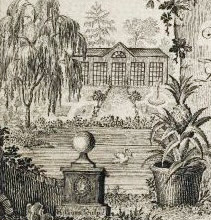
Horticulture was a very significant component of the economy of Middlesex from at least the 17th century and into the 20th. Most local histories remark upon the substantial amount of market gardening which supported London’s growing population at this period but say little of the nursery gardeners.
While both forms of gardening were practised in the area from the 17th century, the nursery gardens evolved to meet changing markets and some became market gardens in their turn in the Victorian period.
Garden historians have tended to concentrate on garden design, mentioning only a few of the major nurseries. The remarkable work of John H Harvey, in Early Gardening Catalogues (1972) and Early Nurserymen (1974), is the exception that proves the rule.
This Nursery Gardeners Archive is designed to give the gardeners back a significant place in the history of the area, especially in the parishes along the Thames. It combines business history, family history and local history in its short essays. In them I make use of a variety of historical sources, including wills, letters, maps and records of property transactions to place the gardeners and their families in local communities. My initial work has concentrated on the Thames-side parishes, especially Chiswick and Brentford which I know best. Val Bott
This website has been accepted by the UK Web Archive
A black and white image of Erica ampullacea appears in John Harvey’s Early Nurserymen (Phillimore 1974). Harvey gives the source as plate 303 in Volume IX of Curtis’ Botanical Magazine published in 1795. However, a little searching online revealed a tinted copy of the image and Curtis’ accompanying text since the publication has been digitised by Project Gutenburg.
It is clear that Curtis was impressed with his visit to Williams’ nursery at Turnham Green. He described the plant as a “Flask Heath”. He wrote: The Erica here figured has some affinity in the form of its flowers to the E. ventricosa, as these in their shape resemble a flask or bottle, especially of that kind in which water is usually kept, we have named it ampullacea; it is of very modern introduction”.
A full description follows:
On the 11th of June 1784, we had the pleasure to see a small plant of this species in flower, with Mr. Williams, Nurseryman, Turnham-Green, an unwearied and ingenious cultivator of this beautiful tribe of plants in particular, the richness of whose collection will appear in the subsequent list; by him it was raised from Cape seeds, though not more than the height of ten inches, it produced eighteen branches, most of which put forth flowers at their summits; we counted sixty-six blossoms on this small plant.
The leaves are short, linear, somewhat triangular, rigid, edged with fine crooked hairs, very visible when magnified, and terminating in a mucro or point, on the older branches recurved and mostly eight-rowed; each branch is usually terminated by four or five flowers, at first growing closely together, and covered so strongly with a glutinous substance, as to look as if varnished, and which is so adhesive as to catch ants and small flies; as the flowering advances, they separate more widely from each other, and finally a young branch grows out of the centre from betwixt them; the true calyx is composed of four lanceolate leaves, sitting close to and glued as it were to the corolla; besides these, there are several other leaves, which might be mistaken for those of the calyx, but which may with more propriety be called Bracteæ or Floral-leaves; some of these, like the calyx, are wholly red, others red and green mixed together, and broader than the leaves of the plant; the flowers are about an inch and a quarter in length, inflated below, and contracted above into a long narrow neck, dilating again so as to form a kind of knob, in which the antheræ are contained, just below the limb, which divides into four somewhat ovate obtuse segments, the upper side of these segments is of a very pale flesh colour, the under side of them as well as the dilated part just below them bright red, the body of the flower flesh colour, marked with eight longitudinal stripes, of a deeper hue; filaments eight, antheræ within the tube; style projecting about the eighth of an inch beyond the corolla; stigma, a round glutinous head.
The flowers as they decay become of a deeper red colour, and finally pale brown, still retaining their form and appearing to advantage;—hitherto the plant has produced no seeds here, is increased with difficulty either by cuttings or layers, but with most certainty in the latter way.
Curtis also published the list of the heathers grown by Richard Williams which appears below. It is clear that this was a real specialism of the Chiswick Nursery in the 1780s and ’90s. It is remarkable to have this clear and enthusiastic description of Williams’ achievements!
A Catalogue of Heaths, cultivated and sold by Richard Williams, at his Nursery, Turnham-Green, Middlesex.
N.B. Those marked with an asterisk have tubular flowers.
One of the great things about sharing my research on this website is the fact that it brings me interesting queries and contacts. I was recently approached by Ian Baggott of CFP consultancy who has been commissioned to work on a conservation management plan for Neath Port Talbot council which runs The Gnoll as a public park.
The listing description prepared by CADW is very useful and I have been transcribing some of the 1720s letters to which this refers. They show that Thomas Greening Snr was working there with Herbert Mackworth from at least 1724. By this date he was improving Sir James Bateman’s gardens at Shobdon in Herefordshire, where he also bought a farm of his own. Travelling from there into Wales was a much more realistic proposition than the journey from his nursery garden at Brentford!
One of the letters suggests that he supervised the work at The Gnoll through occasional visits – “Greening was here a few days since and protested to me that he never saw any thing in his life more properly layd out”. He would have needed an experienced foreman, upon whom he could rely, and a skilled team.
The landscaping at The Gnoll includes a very ambitious cascade, restored in 1995, which I visited in 2018. The 1740 map below shows the lake into which the cascade descends and the numerous other water courses on the estate, used for industrial purposes as well as ornament. The circular feature near the mansion (on the left) may have been the bowling green, referred to in a letter from September 1727 on which work was not expected to start until the next year. In my discussion with David Jacques about this garden he described the irregularly-laid out pleasure grounds behind the house as ‘quite a la moderne’ for the period. Today it is harder to interpret the landscape as much is overgrown and only footings and fragments of the house remain, but I look forward to a return visit in the future when the new CMP may have prompted regeneration of the estate.
The Gnoll with the straight line of the cascade bottom right, from a map of 1740.
I shall be talking about some of the innovative Georgian nursery gardening families who worked in what is now West London on 12 October 2021. Though I have spoken about these gardeners before, this presentation will include some new material.
This online talk is part of the Gunnersbury Park talks programme and you can book a place at £7 here
When a researcher approached the Barnes & Mortlake History Society seeking information on a family of Barnes gardeners named Blinde or Blind I was asked whether I could help. The inquirer was following up a mention of a Mr Joseph Blinde, gardener at Barnes, in the first edition of Philip Miller’s Gardeners’ Dictionary (1731). Blinde had found growing wild in Barnes a double-flowered form of Saxifraga Granulata (Meadow Saxifrage), ‘transplanted it into his garden and afterwards distributed it to several curious persons; since which time it hath been multiplied so much, as to become a very common plant in most gardens near London, where it is commonly planted in pots, to adorn court-yards &c in the Spring’.
Miller’s mention of Joseph Blinde
Who was Joseph Blinde? Miller’s mention of him suggests that he had some standing in contemporary horticultural circles. The original inquirer had shared two wills [i] from the Surrey History Centre. One was for a Joseph Blinde of Barnes and its contents suggested that this was probably the man who found the double-flowered Saxifrage.
Though a Blinde family archive does not appear to have survived, as is the case for most 17th / 18th century gardeners, it may be possible to discover his name in some of his customers’ accounts in order to understand the size of his business. Information from other researchers is welcome.
When James Wisdom and I studied the accounts kept by Arthur Palmer, the steward to Lord Fauconberg of Sutton Court in Chiswick, we found several payments to a ‘Mr Blind’. The first was in October 1693 ‘for plants’ at £3.10s and in the same month the waterman, John Hearn, was paid 7 shillings ‘for bringing 56 trees from Mr Blind’. Another £8 was paid for two bills ‘for plants’ in August 1698 and £2 ‘for hollies’ the following September. A year later, in October 1699, £6 was paid for 8 hollies [ii]. Joseph Blinde’s hollies may have been particularly fine, though Fauconberg had purchased them in the 1680s from other suppliers.
The marriage of this Joseph Blinde and Elizabeth White, both ‘of Barnes’, took place at St Mildred Poultry in the City of London in 1687, but it was the Barnes parish registers (available online) that recorded their children’s baptisms. The first I traced was a daughter, also Elizabeth, baptised in June 1689 but buried in August 1690, the same year in which her brother, John, was baptised and buried. Two more daughters and a son were born in the 1690s, all dying in infancy. After a long gap, another Elizabeth was baptised in 1708, then Mary who lived from 1710 to 1714. Only this second Elizabeth seems to have survived into adulthood.
Nursery gardens were family businesses so the two Elizabeths, mother and daughter, would have worked alongside Joseph. After his wife died in 1732 he wrote his own will the following year [iii]. His witnesses included father and son, Edward and John Courtney. Edward’s will shows he was a Barnes barber and perriwig-maker who bequeathed a house and garden with an arbour, a pump-well and a necessary house (or privy) plus adjoining garden ground. Was he one of Joseph’s customers or simply a local friend?
Joseph Blind’s shaky signature on his will of 1733 (Lambeth Palace Library VH 96-272 a)
Joseph left his entire estate to his beloved daughter, Elizabeth – freehold and copyhold land in Barnes, garden stock, household goods, money and personal property. She could sell part of his Barnes freehold property if necessary to pay the entry fine on the copyhold property but he surely expected her to continue running his garden grounds. In April 1738, at St Luke’s Chelsea, she had married another gardener, William Blows; the note confirming the grant of probate written on her father’s will in February 1740 confirms that she was now Elizabeth Blows.
Where had Joseph gained his expertise? Probably from his father, gardener William Blinde Snr, who died aged 63 in 1693. One of the witnesses to William’s will [iv] was Richard Pearson, the Mortlake schoolmaster; according to John H Harvey’s Early Nurserymen (1974) Pearson was related to a family of Hoxton gardeners and two of his sons were apprenticed to gardeners. Online family history records show that William had married Anne Node, both described as ‘of Barnes’, at St Andrew Holborn in 1651, though he was buried in the Quaker Burying Ground in Hammersmith [v]. His will in Lambeth Palace Library was made on 14 May, when he was ill, and proved on the 25th. He left the residue of his estate to Anne and their son Joseph ‘share and share alike’. They were to benefit from his garden grounds and stock for their natural lives and Joseph’s children were to inherit his share should he die before his mother. This would ensure that the business continued with a prosperous future.
William Snr made money bequests to his other sons, John and William, and to his daughter, Love. She had married Nathaniel Snignall, with whom she had two children, but she was widowed by the time her father died. John had married Mary Partridge, both ‘of Barnes’ at St Mildred Poultry in the City of London in 1686. He was working garden grounds in Brompton, Kensington, and took on apprentices there in 1712 (John Edsar) and 1723 (Henry Stevenson). He died in 1729.
Maisie Brown wrote up the 1693 inventory of William Blinde Snr’s estate in the June 1992 issue of the Barnes & Mortlake History Society Newsletter. It described Blinde’s house as having a parlour, kitchen, buttery, main bed-chamber and a long chamber for the servants. His well-furnished parlour had a clock, 14 pewter dishes and an ample supply of table linen. The house contents plus £10 ‘in cash and debts owing to him’ were valued at £34.12s.6d while his garden stock, listed separately, was valued at £139.18s.0d, a substantial sum.
Maisie Brown wrote: “His nursery stocked apple, pear, cherry, lime, elm, plane and walnut trees, together with crab apple, plum, cherry and pear stocks for grafting. They were valued at nearly £32. Other items such as large quantities of holly, yew, juniper, myrtle, laurel, box, fir and cypress came to £50. The main interest of the inventory lies, however, in the highly specialised list of plants which at the time were rarities. Whilst ‘all the ordinary sorts of flowers’ are lumped together as a single item valued at £5, the rarer beauties are carefully listed and valued in total at £55. These were ‘tulups, emanayes, junkquills, renonkalists, arickaleses, polyantayes and jelly flowers’, or, as we know them today, tulips, anemones, jonquils, ranunculus, auriculas, polyanthus and carnations. All were either relative newcomers from abroad or native flowers which had been improved in colour and form.”
So the nursery held a good range of fruit trees and plants for the kitchen garden, shrubs and trees for the pleasure garden, including hedging plants for formal garden designs, and expensive flowering plants – some relatively recently introduced from overseas.
Rose House, 70 Barnes High Street
Elizabeth Blows drafted her will in November 1757. Her witnesses included the Mortlake schoolmasters, Jonathan and John Wild Tomlinson. Her husband was her primary heir and her executor. She left him Barnes properties held in her own name (probably those inherited from her father, Joseph) – Rose House with its garden (which still stands) and the Peaked Acre in West Field (then occupied by Richard Clemenshaw) – with both to go to their daughter, another Elizabeth, after her father’s death.
Barnes Terrace with malthouses, Thames Panorama of 1829
She also left her husband freehold tenements and a malt-house on Barnes Wharf. In the first draft of her will Elizabeth left him another 5 acres of copyhold land in Windmill Field but in a codicil written a few days later offered him the alternative of a messuage and 3 acres called Gibbons Close, then occupied by Samuel Taylor and Abigail Partington.
Barnes West Field sketch map which records Peaked Acre as ‘Piked Acre’
Elizabeth’s widower lived until 1768. Their son William, born in 1745, was listed as a gardener in the Jury-Qualified Freeholders and Copyholders Lists [vi] with property in Barnes in 1770. He was also recorded in the London Poll Books [vii] in 1774, with property in Barnes which he owned and occupied. However, by 1780 he was resident in Isleworth and his Barnes property was occupied by Abraham Ayton, a Brentford maltster.
In May 1786 The European Magazine recorded William Blows, market gardener and seedsman of Isleworth, as a newly-declared bankrupt so this was probably the end of this gardening business. William died aged 71 and was buried at All Saints Isleworth in 1816, where his most recent residence was recorded in the register as St Dunstans.
This is an expanded version of the article published in the Barnes & Mortlake History SocietyNewsletter 236, March 2021, from which the sketch map is taken
[i] QS3/10A/1–9. Digitized images. Surrey History Centre
 Horticulture was a very significant component of the economy of Middlesex from at least the 17th century and into the 20th. Most local histories remark upon the substantial amount of market gardening which supported London’s growing population at this period but say little of the nursery gardeners.


