Reputations

Lawrence on Parker 1714
Lawrence praises Nicholas Parker, 1714

A reputation for  reliability and quality was the key to success in business for 17th and 18th century nursery gardeners. This could be influenced by many factors, from a gardener’s training, through early employment, to the respect of patrons and colleagues. Personal testimonials passed on by satisfied customers were invaluable, while the emerging genre of gardening books saw individual gardeners appearing in lists of subscribers and as beneficiaries of writers’ comments.

Gardening dynasties

Some nursery gardens were owned and managed very successfully over a long period by a single family. A number of those described on this website ran through several generations, some making the transition from 18th century nursery garden to 19th century market garden with great success.

The Greening, Kennedy, Masters, Ronalds and Woodman families sustained their good reputations through several generations. Those who prospered (or inherited well from their parents) became gentlemen and moved into another world, another class.

Hugill indenture 1798 (Layton Collection)
William Hugill’s indenture
(Layton Collection)

Training and apprenticeships
While many nursery gardeners trained their own offspring to support the family business, local gardeners also took on apprentices. In August 1716 Powell Pearson, the son of the schoolmaster at Mortlake, Surrey, was apprenticed to Thomas Greening snr of Brentford, further upstream on the Middlesex bank (1). Hugh Ronalds took on William Hugill, a poor boy funded by a local parish charity, as apprentice in 1798. Some nursery businesses came to an end in the absence of a son or nephew to train up as heir, while other sons were prudently placed as apprentices in different trades and crafts.

Two parish officials in Kew had a difficult situation to deal with in 1749. Chapelwarden John Dillman, one of the royal gardeners, and nurseryman Richard Butt placed Cornelius, the son of gardener John Edwards, as apprentice to a glazier in St James’s. Cornelius’ behaviour was so bad that the glazier petitioned for him to be removed. Young Cornelius Edwards had destroyed his reputation at an early age and one wonders whether placing him at some distance from his family might have been “for his own good” (2).

Personal recommendations
In a world where communication was a much slower process than today’s, referrals from satisfied customers, previous employers and admiring colleagues were crucially important.

Kew print cartouche
Rocque’s dedication to the Greenings

John Rocque acknowledged members of the Greening family by dedicating to them his plan of the gardens at Kew which they managed.

Thomas Knowlton frequently mentioned other gardeners in his correspondence. Aware of this, his proteges, the Scott brothers made sure he knew what they were doing. For example, in a letter of November 1754 to William Stonehouse, gardener to R Richardson, he described a print of Sarracenia Purpurea grown by James Scott in Turnham Green and the new trade card issued by Henry Scott, his brother, stating that the latter was “the neatest thing of the Kind I have seen, he sent me one down”(3).

But personal comment could also cause difficulties. Henry Woodman was from 1729 supplying plants and seeds to Henry Ellison for Gateshead Park. The contracts came to an end in 1733, because another gardener, Stephen Switzer, had convinced Ellison that Woodman was fixing his prices in league with Ellison’s agent, Woolley. Though Woodman’s prices were comparable to those of his contemporaries Woolley lost his post and, after receiving indignant letters from Woodman denying that he would ever do such a thing, Ellison placed the matter in the hands of a lawyer. No further letters survive to show how this was resolved. Switzer, however, succeeded in supplanting Woodman at Gateshead Park (4).

Fellow Gardeners
Though they were commercial competitors, most nursery gardeners were part of a community bound by friendship and marriage; they shared information, admired achievements and purchased from each other. The inventory prepared on the death of gardener John Asslett of Old Brentford in 1748 revealed a considerable list of creditors (5), amongst whom were numerous significant gardeners from the surrounding area. If they were purchasing from Asslett they must have trusted the quality of plants he supplied. As the preparation of a nursery inventory required horticultural expertise, Asslett’s widow brought in two respected gardeners to assist her, Thomas Ash of Twickenham and Richard Butt of Kew.

AURICULAS
Auriculas

During the 18th century gardeners’ societies and clubs provided opportunities for presenting plants or fruits at meetings and for cementing friendships. A feast for about 130 florists, specialists in flower-cultivation, was reported in The Craftsman of 16 April 1729. It took place at The Dog on Richmond Hill. After the dinner several florists presented their flowers, mainly auriculas, for the judgement of “five ancient and judicious Gardiners”. Silver spoons and ladles were awarded as prizes; two spoons and one ladle going to a single Barnes gardener who excelled (6).

After the Horticultural Society of London (now the RHS) was established in 1804 high quality examples of fruit and flowers, some newly introduced, were regularly presented to members’ meetings and given awards. Displays and awards of this kind were of value to individual gardeners and were also a source of pride to the employers of estate gardeners. William Cock jnr of Chiswick won the Silver Knightian medal for his pelargoniums in 1839; he had won a Large Silver Medal for plants of the same variety in 1810 and continued to win awards each year. The family’s garden ground lay between Chiswick House and Hogarth’s House; William Cock jnr described himself as market gardener in his will (7) so pelargoniums must have been his hobby.

Patrons and supporters

Nicholas Parker of Strand on the Green was a very successful Chiswick gardener. He supplied standard trees, yews and fruit trees for Lord Fauconberg’s new gardens at nearby Sutton Court in the 1680s and 1690. And Lord Ashburnham, who also owned an estate in Chiswick, contracted him to work on his Ampthill Park gardens in Bedfordshire between 1697 and 1707 (8). Though he married twice, Parker mentioned no surviving children in his will. Instead, he made thoughtful bequests of property to members of the Compton family, related to him by marriage, and to Henry Woodman, who was probably his foreman. This enabled Henry to marry one of the Compton heirs and establish his own nursery on part of Parker’s garden ground.

William Murfin was recommended for the post of head gardener at Chiswick House in 1789 by William Speechly, the Duke of Portland’s gardener at Welbeck. Murfin was trained at Castle Howard by Robert Teesdale who had recommended him 20 years earlier to Doncaster estate and now recommended him again (9). William Murfin’s nephew, Robert Clews, was trained by William’s brother, Robert Murfin; he succeeded William as head gardener at Chiswick and became a Fellow of the Horticultural Society. In 1823 he exhibited there varieties of grapes and in 1830 two varieties of apple named after him.

In the 17th and early 18th centuries, many Scots gardeners travelled south to find work on big estates. Some came to posts with aristocratic members of the Stuart court who had been awarded landed estates by the King. Others came for political reasons, or perhaps because there was more likelihood of prosperity in the gardens of the south of England. The Scotts were working in Chiswick in the late 1730s while the Ronalds’ nursery was established in New Brentford in the mid 1740s. Sir Joseph Banks, who had a house at Isleworth, knew and trusted Hugh Ronalds snr, whose nursery ground lay nearby in New Brentford. Banks placed substantial (and profitable) orders with Ronalds for plants to send to Australia.

Gardeners who worked as contractors, like Capability Brown, employed experienced and skillful managers to oversee their contracts. In 1765 Brown placed Michael Milliken, a Scot who had worked for him at Chatsworth for 10 years, to supervise work on the King’s Richmond Gardens at Kew. There Milliken stayed for 35 years – his touching letters to his wife and his will show that this was immensely profitable (10).

John Lawrence Clergyman's Recreation 1714
John Lawrence Clergyman’s Recreation 1714

Catalogues and handbooks
John Lawrence, in the preface to his book of 1714, The Clergyman’s Recreation, mentions the famous owners of the great nursery at Brompton, South Kensington, London and Wise, but also singles out Nicholas Parker of Strand on the Green for praise. He describes him as “that honest person I have so long dealt with and so often recommended” and comments on the reliability of more than 500 fruit trees supplied by him.

Despite the dispute mentioned above, the quality of the plants Henry Woodman supplied was endorsed by Thomas Hitt, another distinguished gardener, in his book A Treatise of Fruit-Trees (1755): “I must own I have received peach-trees and nectarines from Mr Henry Woodman of Strand on the Green in the county of Middlesex which I planted for the Reverend Mr Ewer of Bottisford near Belvoir Castle; all of them lived and some bore fruit the first year after planting, tho’ they were brought above a hundred miles, and only packed up with straw and matts; they have been planted nine years and are now strong healthy trees.”

Swinden Title Page
Nathaniel Swinden included a catalogue of seeds in his book of 1778

Barnaby Millett, Lord Burlington’s head gardener at Chiswick, was described by Richard Bradley in various works between 1718 and 1724 as a “very ingenious gardener” skilled in the early ripening of strawberries and of cherries and apricots in frames (11). Nathaniel Swinden on the other hand, relied on a little elegant self-promotion. His book was not only full of useful advice on gardening but also acted as a catalogue of seeds which he could supply. And in a rather modern approach, Swinden offered boxes and baskets of selected seeds enabling purchasers to implement designs he had proposed in the book.

Obituaries
Unlike today’s published obituaries only occasionally did 18th and early 19th century death notices include more than a bare statement of a gardener’s death and the sadness of the surviving relatives. But by then it was too late to tell the deceased gardener of the esteem of the community of gardeners, which one hopes had been expressed in life!

References & Sources

(1)  Apprenticeship Registers via ancestry.co.uk
(2)  Westminster Session,Justices’ Working Documents April 1751 accessed through londonlives.org
(3)  No Ordinary Gardener: Thomas Knowlton 1691-1781, Blanche Henrey, British Museum (Natural History) 1986 pp 230-1
(4)  full transcripts of the correspondence in Early Nurserymen, John H Harvey, Phillimore, 1974
(5)  TNA PROB 3/48/2
(6)  quoted in English Florists’ Societies and Feasts in the 17th and First Half of the 18th Centuries, Ruth E Duthie, Garden History 10, No 1 (Spring, 1982), pp 17-35
(7)  TNA PROB 11/2052
(8)  Letter books of John 1st Baron Ashburnham Jan 1696 to Mar 1705, East Sussex Record Office ASH 840-845
(9)  correspondence in Chatsworth Archives, quoted in Chiswick House Grounds Historical Survey, P6327, David Jacques (Travers Morgan for DoE), 1983
(10)  Letters in private archive, quoted in Capability Brown, Dorothy Stroud, Country Life, 1950, and TNA PROB 11/1139
(11)  from Garden History 11, No 1 p 33, quoted in Chiswick House Grounds Historical Survey, P6327, David Jacques (Travers Morgan for DoE), 1983

Flower pots and forcing jars

Local brickearth and clay supported the manufacture of bricks, tiles and garden pottery in Brentford from the 17th to the 19th centuries. The Bull Lane Pottery is recorded in a naive painting of the 1840s, which shows its garden products.

Local brickearth and clay supported the manufacture of bricks, tiles and garden pottery in Brentford. Much good quality clay came from Coles Hole, a deep excavation which survives today – it is the Potomac Lake in Gunnersbury Park. The Rothschilds bought it to extend their grounds and adapted the adjoining tile-kiln to be a gothic boat-house on its banks.

The potters would probably have used the local clays, which fired red, to basic domestic pottery as well as high quality roof and flooring tiles and chimney pots for local builders to use. Given the number of large estate gardens, numerous nursery gardeners and market gardeners in this area of Middlesex they must also have had a ready market for flower pots (both plain and ornamental), forcing jars and garden urns.  For example, the inventory of George Masters of Strand on the Green in 1734 included a hundred small garden pots, worth 6 shillings, and 4 watering pots valued at a shilling each.

Potteries are mentioned in a number of sources. In the 17th century potters were paying rates in New Brentford – John Robins in 1693 and Richard Yeoman in 1699. Wealthy brickmaker, James Barratt Snr, owned the ‘pothouse’ which lay behind his pub, The Bull, in Old Brentford at his death in 1750. This descended through the marriage of Barratt’s grand-daughter to Sir Thomas Edwardes.

From the 1760s the Bull Lane pottery was leased from him by the Turner family. They invested in the business, putting up 14 cottages – Pot House Row – for their workers by about 1780, and running what was described as an ‘extensive pottery’ in a 1797 directory. At his death in 1791, Daniel Turner, the proprietor, was very comfortably off. His will mentions his chariot and horses and his plate, china and books and he also had farmland, farming equipment, crops and animals. He left the business including his stock and ‘Pottery Implements’  to his widow Elizabeth and son Thomas, to be run as “Turner Widow & Son”. They were to take equal shares of the profits. On Elizabeth’s death, her other son, Daniel, was to take a half share in the business. The business seems to have failed in 1820 as the stock was auctioned off – perhaps the sons were not so astute as their father had been.

A pottery continued here until at least the 1890s; it is remembered today in Pottery Road.

This remarkable painting shows the interior of the Bull Lane Pottery in Brentford in the 1840s. It can be dated by the name “George Robinson” on the chimney pots, as he owned the pottery throughout that decade. The whereabouts of the painting today are not known but this photograph was taken for Gunnersbury Park Museum when it was unable to afford to buy it at an auction in the 1980s.

The building was constructed from brick with an unplastered timber ceiling and the leaded mullioned windows suggest that it dated from the late 17th century. The potter on the left is forming a large forcing jar with a conical lid and has tall chimney pots waiting to be taken to the kiln on the board alongside his wheel. He has to stand on a step to handle the clay for these substantial products so cannot reach his foot pedal – instead it is being operated by a boy using a lever beneath the table.

The potter on the right is holding up a garden urn; it is unlikely that it was manufactured in one piece on his wheel in this form, though he has his foot on the pedal beneath the table to operate his wheel. This is probably a pose for the painting. Alongside are weighed out equal slabs of clay – more are being brought to the potters by the man on the right. A row of small flowerpots stands on a ware-board beside him, ready for carriage to the kilns.

The children posed in the foreground for the picture have a toy wheelbarrow, a straw hat and their pet animals. It seem unlikely that they would be allowed into the workshop in their best clothes on any other occasion!


Additional note, 14.04.2013

A piece posted on 27 March on Pam Woolliscroft’s Spode history blog provides another view of pottery products for gardeners. It considers those made by Spode and by Copeland and Garrett and in passing mentions Mr Ashford, a red potter of Clapham, Surrey, with illustrations of his fine double flower pots.

Henry Woodman & Eleanor Compton

Henry Woodman, his father, his brother and his son were gardeners in Strand on the Green in the 18th century. However, the women of the family were also skilled at running a gardening business, especially Henry’s mother Esther and his long-lived wife, Eleanor.

In 1726 Nicholas Parker left the remainder of his lease on land in Sutton Field, Chiswick, and the stock growing upon it, to “my servant Henry Woodman”, who must have been a high-ranking employee, perhaps the manager of the nursery. Henry Woodman was born in 1698, one of four children of another Henry Woodman, described variously as “husbandman” and as “gardiner”, who had married Esther Durham in 1694. When Henry senior died in July 1701, Esther had three young sons to care for; she gave birth to their daughter, Mary, in September.

Esther lived on until 1784. Two of her sons, Henry and John, were described as gardeners so it is likely that she kept the nursery going. Lady Susanna Lort, who took the Chiswick mansion house which was later known as Heathfield House, employed her to weed her gardens, bequeathing her twenty shillings in her will of 1710. John Harvey thought that Henry Woodman may have inherited his garden from George Masters but both men are listed in the rate-books at the same time, rather than one as successor to the other. From 1727 Woodman’s property was assessed at £45 in the rate books; this was a far higher value than Parker’s Sutton Field alone so must have included the Woodman family nursery too. He was now sufficiently well established to marry Eleanor Compton at St Paul’s Cathedral in 1728, reuniting two of Parker’s bequests.

Henry and Eleanor’s first two children died when only a few days old in 1730 and 1732, but their third child, Henry (1732-1774), worked in partnership with his mother after his father’s death. The daughters were Elizabeth, who married John Kirk, Mary (1741-1770) and Eleanor, who married Thomas Allen in 1768. “Kirk and Allen” were paying land tax on jointly owned properties on Strand on the Green in the 1790s and the 1847 tithe apportionment lists small market gardens then held by Kirk and Allen, so gardening continued with later generations of the family.

Henry Woodman was a subscriber to Philip Miller’s Gardener’s Dictionary of 1731, confirming that he was one of the prominent gardeners of his day. His surviving correspondence shows that between 1729 and 1733 he was supplying substantial quantities of plants and seeds to Henry Ellison of Gateshead Park in County Durham. The letters, mostly to Ellison’s agent, Woolley, are chatty and informative, and advise on planting and protection from frost. Woodman visited Gateshead and sends his best wishes to people he had met there. His letters apologise for delays in finding reliable boats to take the plants up the east coast to Gateshead but usually name each vessel and its master.

In October 1730 he mentions being able to supply “a new sort of pea that beats all I ever saw” and says that he has been “bussey” building a green house “a conveniency I very much wanted”. He also comments on the weather: in 1730 “We have had vast plenty of all sorts of fruit this year and Exceeding Cheap” but in 1731 “the dryness of the summer has made Standard peaches and Nectarines very scarce”.

The invoices list a variety of plants. In October 1729 Woodman sent 26 plums, 30 peaches and nectarines, 34 pears, 20 cherries, 15 apricots, 48 apples on paradise stocks, 108 gooseberries and currants, 6 berberies without stones, 200 raspberries and 400 strawberries. There were also flowering plants, damask roses, honeysuckles, anemones, polyanthus, mixed tulips, anemones, striped lilies, crown imperials, Persian iris, hepaticas, snowdrops and crocus and 50 auriculas.

The following December he fulfilled a substantial order of seeds for nearly forty different kinds of vegetables and herbs, plus 100 asparagus roots, plus carnation layers, double white rocket and another 100 strawberries. Woodman wrote in January 1730 “The Cowcumber & Mellon seed you may depend on to be as good (as) any in England haveing saved it all myselfe”, though later that year he advised Woolley to buy directly (and more cheaply) from Moses James of Lambeth, his usual seedsman.

Late in 1731 he sent trees and hedging plants (200 6 ft-tall elms and 1500 hornbeams at 2 feet) with flowering shrubs and more fruit trees. In early 1732 he wrote to advise on the growing heights of the 1000 flowering shrubs he was supplying to help with the design of the planting, an approach which Nathaniel Swinden of New Brentford was to develop in The Beauties of Flora Displayed in 1778.  He continued to send plants and seeds to the end of 1733.

By then another gardener, Stephen Switzer, had convinced Ellison that Woodman was fixing his prices in league with Woolley. The latter lost his post and after indignant letters from Woodman denying that he would ever do such a thing, Ellison placed the matter in the hands of a lawyer. Harvey considered Woodman’s prices comparable to other contemporary nurserymen but no further letters survive to show how this was resolved. Switzer, however, succeeded in supplanting Woodman at Gateshead Park.

In 1755 the quality of the plants Woodman supplied was endorsed by Thomas Hitt, another distinguished gardener, in his book A Treatise of Fruit-Trees.

“I must own I have received peach-trees and   nectarines from Mr Henry Woodman of Strand on the Green in the county of Middlesex which I planted for the Reverend Mr Ewer of Bottisford near Belvoir Castle; all of them lived and some bore fruit the first year after planting, tho’ they were brought above a hundred miles, and only packed up with straw and matts; they have been planted nine years and are now strong healthy trees.”

Henry Woodman was a respected member of his community and served as a churchwarden in 1739/40. When he died in 1758 he was buried at St Nicholas where the register records that they had fulfilled his request to be buried 12 feet deep. His will left over £1,000 in bank annuities to be managed in trust by his widow, Eleanor, and by William Martin, a maltster and Strand on the Green neighbour.

Of Henry and Eleanor’s five surviving children, four were under 21 when he made his will in June 1755. He added a codicil a year later, changing his bequests after his daughter, Elizabeth, had married and his son William, “who is now lame”, had died. Worried about this lame son, Henry had provided for the legacies left to his other children to go to William should they die before him.

Eleanor Woodman was a strong, resourceful and reliable woman who was deeply involved in the nursery garden for many years more. Eleanor was executor to her brother William and witness to the will of her brother Nicholas. William Compton left a New Brentford freehold and his own house “fronting the Thames” on Strand on the Green, as well as nearby garden ground, to his nephew Henry Woodman Junior, on condition that he continued to work in co-partnership with his mother, but in the event she outlived him.

Eleanor’s own will, proved in 1784, shows her astute financial management. She left £2,000 in 3½% bank stock, twice the £1,000 she had taken over in 1758 as executrix to her husband. She appointed two nephews-in- law as trustees, William Wake and Thomas Hearne, along with Charles Rubery of Sutton Court Farm. (Thomas Hearne senior, another local gardener, had married Eleanor’s sister). She left her Strand on the Green house to her daughter Elizabeth Allen, revealing in passing that she has already moved out “to Chiswick”, with her servant Mary Hoskins. There are bequests to sons in law, grandsons and nieces and nephews, but it appears that apart from Elizabeth all her other children had died.

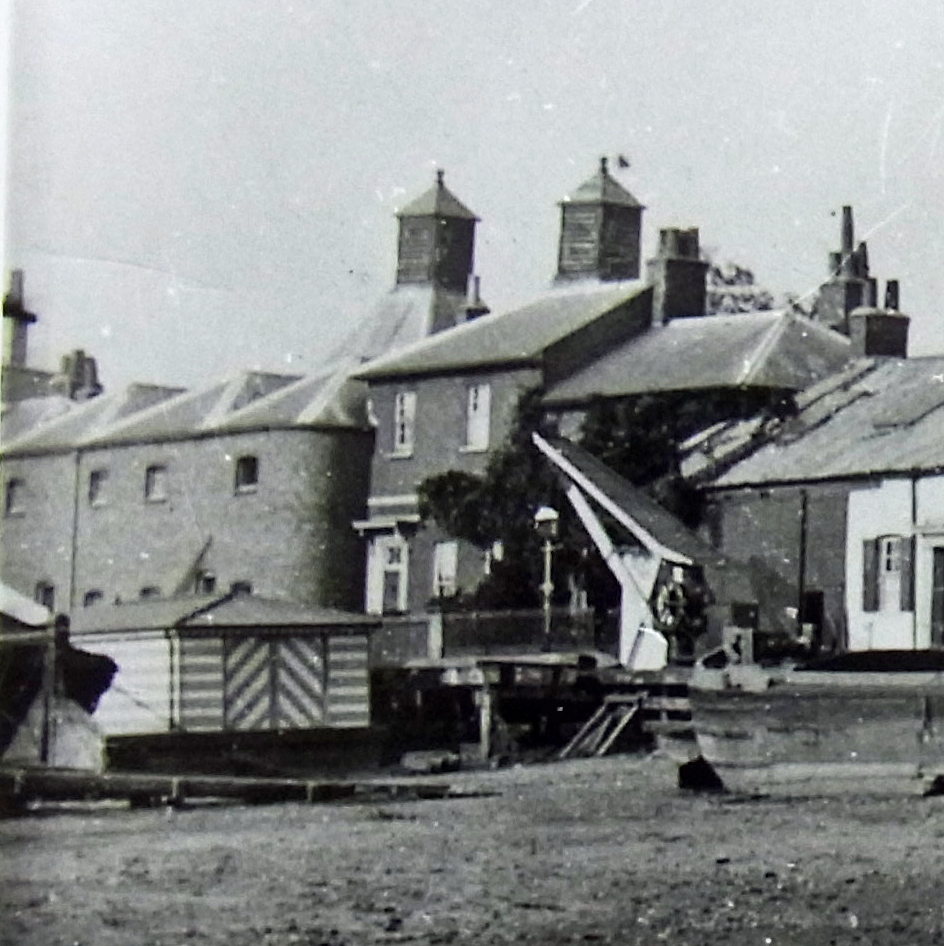
Strand on the Green, about 1875. The Woodman home was next to the malthouse on the left – the houses, workshop and boat yard in the centre stand where Henry’s walled garden once was.

In the early 1970s Kathleen Judges, the Strand on the Green historian, identified the 6-acre plot which descended from Parker via the Comptons to the Woodmans as lying on the north east side of today’s Thames Road, and a further half acre on the Thames as being a plot which was a market garden on the Tithe Map of 1847. Later owned by the Port of London Authority, it lies immediately downstream of Picton House (which she identified as Henry and Eleanor’s most likely home) and was sold by the PLA for a housing development in 1971.

WOODMAN FAMILY TREE

Nicholas Parker

Nicholas Parker was a wealthy gardener who lived on Strand on the Green. After his death in 1726, his bequests to Henry Woodman and his future wife Eleanor Compton, and to other members of the Compton family, ensured the continuation of the garden grounds in skilled hands.

Nicholas Parker

The accounts kept by the Earl of Fauconberg’s steward, Arthur Palmer, record substantial expenditure on the Earl’s new gardens at Sutton Court, Chiswick between 1685 and 1700. The name of Nicholas Parker recurs regularly in Palmer’s account book. Parker supplied plants, sometimes in large quantities, for the Sutton Court garden. Almost all of the payments made to Nicholas Parker or Mr Parker are for the supply of “trees” with only one entry for “plants”. A few entries are more specific, listing “ew”, 300 hornbeams and 38 phillireas, and in 1685 alone Mr Parker was paid the substantial sum of £17 for fruit trees. Separately, “Goodman Parker” appears against payments of £19.2s and £50 for carpentry, with a further £17 for “digging and wharfing a new pond”.  It is probable that Goodman Parker was Nicholas Senior, father to the gardener.

So far it has not been possible to identify exactly where all of the Parkers’ properties lay.  Nicholas Parker Senior appears in the rate books on Strand on the Green from around 1660; he signed his name as a member of the vestry in 1675 and died in December 1714. Nicholas Parker Junior was not rated identifiably by that name until about 1690. In 1699 he served as churchwarden and in 1709 made a donation of £1 towards work on the north aisle of the parish church. By 1719 he is paying rates on property worth £38 and land in Sutton Field worth £16, almost certainly having taken over land which his father occupied.

Given the quantities of trees supplied to Fauconberg, Nicholas Parker was already a substantial nurseryman by the 1680s, though he does not appear in Harvey’s very comprehensive book, Early Nurserymen. Fortunately a will of June 1725 made by Nicholas Parker of Strand on the Green, “Gardiner”, has survived. In it he requested that he should be buried near his late father at St Nicholas Church, Chiswick.

Though no reference is made in the will to a wife, he seems to have been married twice. His first wife, Elizabeth, was buried in 1688 at St Nicholas; on 11 December 1693 the marriage is recorded between Nicholas Parker, gent, widower, and Mrs Jane Goodwin, widow, by Canterbury licence.

From the lists of Chiswick burials, she may have been the widow of Henry Goodwin, buried in linen in 1687/8, or of another Henry Goodwin buried in 1690. The wealthiest of the Goodwins was living at Sutton Court in 1719. And there were Goodwins who were gardeners, who owned land north of Chiswick High Road, near today’s Chiswick roundabout. There were  Brentford Goodwins as well, including a basket-maker.

In 1709 Nicholas Parker Junior is named by George Warner of Turnham Green as one of two executors “which I esteem as my loving friends”. Parker’s social status as a gentleman is further confirmed by his own “good friends” mentioned in the will. He leaves a guinea each for mourning rings for Mr Thomas and Mr George Barker and appoints another, Thomas Mawson, as executor. The Barkers had owned The Grove estate in Chiswick since the middle ages and its land adjoined Vernon Cottage. Mawson had property on the Strand and owned the brewery which was the predecessor of today’s Griffin Brewery. His family was also comfortably off, and one of his brothers was Bishop of Chichester.

Parker’s bequests reveal him to be a man of property with copyhold houses and land in Turnham Green, Little Sutton and Strand on the Green, held of the manor of Sutton Court, and two freeholds in Catherine Wheel Yard, New Brentford. The freeholds secured the right to vote, and a Nicholas Parker is listed in the 1710 Middlesex Poll Book. At this date Nicholas Parker Senior was still alive so these properties may have come to our gardener as a bequest from his father. The will also includes two properties at Strand on the Green, one with six acres and the other with half an acre of land which Parker occupied himself.

William Compton, Parker’s “kinsman” and one of his executors, inherited most of the property, including a house with five and a half acres of gardens at the downstream end of Strand on the Green, then let to Joseph Miller, the comic actor. Miller leased this house, later named Vernon Cottage,  from 1686 to his death in 1738.  And when Nicholas Compton died in 1760, describing himself as gardener in his will, he bequeathed a house with five and a half acres of gardens which he himself occupied, confirming that this was the house he had inherited. Vernon Cottage is clearly labelled on Leigh’s 1831 Panorama of the Thames, just downstream of the Strand, with a walled garden and at least one glasshouse. William Compton took on responsibility for his brother Nicholas’ five daughters and later left garden grounds to the oldest of them in his own will.

Along with £5 for the poor of Strand on the Green, Parker’s will provided  annuities for various relatives as well as bequests of £50, £100 or £200 to a number of friends and relatives:  Elizabeth Parker “now living with me”, Mary and Ellen Parker, William Goodwin of Shepperton, Thomas Goodwin of Laleham, Katharine and Eleanor Compton of Turnham Green. Parker often uses the word “kinsman” to describe these heirs, suggesting that they may have been his wives’ relations rather than his blood relatives. William Compton’s will reveals that Katharine and Eleanor were the sisters of himself and Nicholas Compton.