This story has grown out of another historian’s research, and confirms my view that sharing discoveries really matters because it enables others to build upon them and reveal more.
Working under the wing of the London Parks & Gardens Trust, Susan Darling wrote a short and intriguing piece about Mrs Wood the Isleworth wheeler or wheelwright on the website celebrating the 300th anniversary in 1716 of Capability Brown’s birth. She examined payments to Brown in the Duke of Northumberland’s accounts in 1754 for the design and construction of a new lake in the north-east of the grounds at Syon. She found that there was a substantial increase in the size of the tradesmen’s bills submitted to the Duke at the same period.
The bills included those from Mr James Wood, a wheelwright. His main work as a wheeler was making and repairing wheels but he also built and repaired carts and barrows, made handles for tool such as pick-axes, mattocks and mallets, and assembled the occasional box. Susan Darling observed that about 10 years on the bills began to be drawn up by the Duke’s foreman for ‘The Widow Wood’ but as time passed she was addressed as Mrs Sarah Wood. Her bills to the Duke began as relatively small amounts for making several barrows at about 5 shillings each and for mending two garden carts. But towards the end of 1767 and into 1768 several bills were drawn up for ‘New Work By Order of Mr Brown’ totalling around £50. Her business built some 22 barrows over the space of just a few months as well as carrying out the usual wheel repairs and tool-making. This time period mirrors precisely when Brown was receiving payments from the Duke, almost certainly away from the newly dug lake.
Woman with a barrow, sketch by Paul Sandby, British Museum Prints & Drawings, 1872,1012.3419
Wanting to discover more about James and Sarah Wood I did some further research on the Wood family. A wheelwright’s work would have been greatly in demand in the local community regardless of the upsurge of business associated with Brown’s work at Syon. Every business and every farm would need carts and wagons. James Wood was sufficiently well established to take on an apprentice, Ralph Cheney, in November 1756, but only a few months later, in January 1757, he made his will and he died that May. He left £1 for a mourning ring for his friend John Prudden of Brentford End. To his maid servant Susannah Heathwell he bequeathed the wages due to her plus a sum of money to make that up to £50, suggesting a strong degree of affection for her. The only family members he mentioned were his brothers, Robert, a Guildford carpenter, and Stephen, a currier whom he nominated as his executors.
So Sarah Wood was not James’ widow; the will of Stephen Wood, describing himself as a wheelwright of Isleworth, reveals that she was his wife. He made his will in January 1766 when he was ill, leaving freehold property in Ockley in Surrey and in Old Brentford and all his personal property to Sarah who was to be his executor. To his brothers Samuel and Joseph he made bequests of £10 each, while to another brother, Robert, and to his sister Mary Boreman, he left 1 gn for a ring. He made provision for an apprenticeship for Samuel’s son, Stephen, to be overseen by two trustees, Thomas Benham, a prosperous gardener, and Vincent Hobby, both of Isleworth.
Susan Darling observed that the “payment of the bills for work at Syon is usually received by Sarah Wood herself but at one point Jeremiah Lockyer, most likely a wheeler, takes over and picks up and signs for the money. Interestingly, a few months later in 1769, it is Sarah Lockyer to whom the bills are made out!”
Here was another lead worth following. As the extract from the parish register confirms, Sarah Wood married Jeremiah Lockyer at St Gregory by St Paul’s in the City of London in July 1769. Her neat signature in the parish register confirms her literacy and the fact that payments were made to her suggests her continuing independence as a tradeswoman. I have not yet found evidence that Jeremiah lived in Isleworth or that he was a wheel-wright, nor have I yet traced wills for him or for Sarah. However, they clearly prospered from the substantial work undertaken at Syon Park in the middle of the 18th century
My thanks to Susan Darling for sharing her research.
Wills of James Wood TNA PROB 11/830 and of Stephen Wood TNA PROB 11/930
Baskets and willow hurdles for sheltering plants from wind and frost were an essential part of the gardener’s equipment. Willow basketwork came in many shapes and sizes: river fish traps, garden seats and arbours, bird cages, containers for for various fruits to protect them in transit, fine baskets for shopping and needlework. Willow growing and basket making in a few Thames-side parishes were once a major part of the local economy, particularly in the market town of Brentford. Unlike most articles on this website this one continues into the 20th century until the trade died out.
Osier willows were being grown on Brentford islands or eyots in 1397 [1]. They were established in Chiswick by 1590 [2] and 71 acres of osier beds were recorded in the parish in 1846 [3]. Several varieties of salix viminalis were planted along the Thames; both the variety and the way they were processed provided willows for different purposes.
John Davidson & Tommy Odell loading bundles of withies, Chiswick Eyot, 1927 (Daily Mirror)
Growing willows
Short twigs of willow, planted 15-18 inches apart with a few buds above ground in the spring [4] in the spring, sprout 6 to 8 branches 8 feet long in one season. Cutting back the first year’s growth provided more withies for new planting. From October to February the branches were harvested with a sharp bill-hook, either cut back almost to ground level – coppicing – or to a 3 or 4 foot stump – pollarding – from which the next year’s crop emerged. Both techniques were used in Chiswick. The cut osiers were bound in bundles with a flexible willow tie and sorted by size before being stored. Some were used fresh and green, some were woven with the bark on. Others were stripped and sun-bleached, some were boiled to enhance their colour. Stored twigs were soaked before use to make them pliable and easier to handle, while for fine work they were split lengthways.
J T Smith, wrote [5] in 1839 that he had seen basket-makers’ huts along the Thames from Fulham to Staines. These were probably for storage under-cover rather than manufacture, as weaving needed fingers that had a little warmth and shelter. The year’s cycle saw spring planting and autumn / winter cutting with the manufacture of baskets going on alongside; family involvement ensured that many hands with different skills were available for work ranging from the heavier labour of planting, cutting and carting to nimble-fingered weaving of small fruit and domestic baskets (often women’s work) and training for children and apprentices.
Many beds were owned or leased by basket-making families, while small-scale makers bought in willow from the growers. Some nursery gardeners also grew willow. Matthew Bowden, whose Brentford family became a major supplier of baskets to London in the 19th century, had a number of beds and was recorded as saying his family had maintained the oldest of these for 70 years in 1855 [6]. In his experience the most luxuriant growth occurred in rich alluvial soils by the river, in ground that was under water at virtually every high tide.
He had seen greatly improved
tidal flows over his beds after the demolition of Old London Bridge, while the introduction
of steam packet boats kept the water turbid, ensuring regular deposits of rich
mud. For size and bulk of crop, he said, nothing surpassed osiers grown between
Chelsea and Richmond bridges but, as demand increased, London’s willow supplies
came increasingly from the Thames and the Kennet in Berkshire and Oxfordshire.
Where were the local osier beds?
The marshy fringes of the river and most of the eyots were overwhelmed regularly at high tides, providing perfect osier beds. For example, narrow plots of low-lying land parallel to Chiswick’s river-bank became part of the field pattern. Leigh’s Thames Panorama shows coppiced osiers all along the Chiswick bank from The Grove to Corney House in 1829. And when The Grove estate was offered for sale in 1831, the particulars included ’15 acres of well-stocked osier ground’. These lay, in part, along a narrow strip outside its walled grounds where Hartington Road’s riverside houses now stand. Jacob Knyff recorded small islands and a bed against the bank with rows of osiers, both coppiced and pollarded, in his 1676 painting of Corney House from the river [7]. Only Chiswick Eyot, the largest at about 3 acres, survives – its willows are still coppiced and help hold the island together.
A 1590 manorial survey [8] describes a field called Cornehithe Acre adjoining a ‘wythy’ at its downstream end, with ‘Sir William Russell’s Pond Yard or Moorey Close’ to the north. Moorey means marshy and the wythy is an osier bed, identifying the very wet area where the Common Sewer, a narrow water-course flowing from Strand on the Green, met the Thames downstream of Russell’s Corney House near St Nicholas Church. The same stream watered another marshy area at Little Sutton, still supporting osier beds in 1846 [9].
The Brent delta and Thames eyots from John Rocque’s map of the Environs of London, 1746
John Rocque’s 1746 map of
London and Environs depicts the islands upstream of today’s Kew Bridge as well
as a complex delta at the confluence of the Brent and the Thames. The Brent
channels divided the delta land into low-lying plots which were known as eyots
or eights.
Leigh’s Panorama, 1829, detail with osiers on islands in foreground near basket manufactory
Nearly 80 years later, Leigh’s Panorama of the Thames shows the distinctive planting of the Brentford islands and bank with coppiced willow. Bowden’s basket manufactory is marked beside the Brewery which owned the old windmill, by then without sails. The largest island, immediately upstream of Kew Bridge, stood higher in the river so was rarely under water. For much of the 18th century the West family ran a pleasure resort there but, even after this closed, the island was not considered suitable for willow cultivation. Downstream of the Bridge, between Kew and Strand on the Green, lay Oliver’s Island, another rarely inundated eyot on which a barge house stood.
Types of baskets
Most baskets were made for
specific purposes. They were essential equipment for nursery-and market-
gardeners. Bulky vegetables like cabbages were packed into loades, round
baskets with handles and lids, about 2ft
high and 3ft wide, tapering towards the base. Bushells and half-bushells were
large round baskets without lids and a barge was a rectangular basket for bundled
items which might be vegetables or plants. A skilled basket-maker could make a bushell
in about an hour.
After George Masters, a Strand on the Green nurseryman, died in 1734 an inventory [10] of his goods was prepared, including bushells and half-bushells, 16 maunds (two-handled baskets) at 6d each and 3 barges at 2s.0d each. The 1748 inventory [11]of Brentford gardener James Asslett’s property included ‘a parcel of Basketts and Basket Cloths in the garrett’ and ’12 Basketts, 12 sieves and 12 half-sieves’ (another size of basket) in his yard, stable and seed shop.
Loading pottles of mulberries into marnes, Thomas Rowlandson c1790, Yale CBA B2001.2.1159
Reading University’s Museum of English Rural Life (MERL) has some 19th century fruit baskets, including pottles. These small conical baskets carried strawberries, grown in Brentford, Chiswick and Isleworth, and raspberries, a speciality of Isleworth and Twickenham. Their tapering shape distributed the weight to avoid crushing the lower fruits. For the trip to market, pottles were packed upright in wide shallow baskets called marnes. Early in the day women porters walked the 8-9 miles to Covent Garden market carrying the marnes on their heads, sometimes twice in the same day for a fee per journey of sixpence [12].
Fruit baskets from the MERL collection: left to right, a nectarine or peach pad, a strawberry pottle and a greengage or plum basket
The accounts [13] of William Murfin, Chiswick House head gardener, provide a glimpse of his basket purchases. In January 1798 he spent £3.3s.6d on baskets from Matthew Bowden and bought £1.7s.6d-worth of pottle baskets from Dell of Brentford. He bought more baskets from Bowden in July 1799. The following January he bought another 3 gross of pottles from Dell at £1.4s and a further batch of Bowden baskets for £2.10s.6d. Given these quantities it is surprising that the Dell family has proved hard to find. The 1780s New Brentford Land Tax lists only Dell’s occupation of a property valued at £1, probably a shed.
The quantities of pottles purchased testify to the scale of Murfin’s strawberry cultivation for the Duke of Devonshire, while the price underlines the fact that, despite being skilled work, pottle-making was poorly paid at under a penny apiece. Indeed, in 1843 Mr E W Lobjoit’s account book [14] mentions pottle baskets made by Brentford girls at even lower prices – 3s.9d per gross for fine cones and 3.3d for coarse cones. Maria Gomm, and Anne, wife of James Gomm were pottle basket makers living in Brentford High Street in 1841 and could have been among Lobjoit’s ‘Brentford girls’.
Willow growers and basket-makers
Wills, land transactions and taxation records reveal that basket-makers owned, leased or shared osier beds. A number of Brentford basket-makers can be identified from the 1690s onwards but, though Brentford families were growing willow on Chiswick eyots, only one Chiswick basket-maker has been traced by name.
The Universal British Directory for 1792 listed 2 Brentford basket-makers: George Dobson – perhaps related to Henry Dobson, making baskets with his sons in Hounslow in the 1860s – and Matthew Bowden, whose business is described below. An 1826 directory [15] lists 6 basket-makers: William Barnsby, Matthew Bowden, John Cooke and Thomas Farrow in Old Brentford, with Charles Butt (in the Market Place) and Richard Widmer, both in New Brentford. Though Mr Barnsby held a £4 property [16] in the early 1800s, this was not an osier bed. By the mid 1820s William Barnsby had a £12 house in Old Brentford; he must have been reputable as he witnessed the 1841 will of prosperous market gardener Allen Malcolm. William’s son John, born 1827, made baskets in Isleworth in 1861. From 1867 John Cooke was making baskets in Hounslow, but Charles Butt and Thomas Farrow seem not to have continued for long.
Mason’s 1853 Directory lists basket-makers Robert Cole and George Wheatley of Brentford End, Elizabeth Dawes of Ealing Lane, James Humphries, Jacob Long (succeeded by Charles Long, near Albany Chapel) and James Nash (described as both a basket-maker and marine store dealer) all in Old Brentford. In 1861 George Wheatley was making baskets with his sons James and Thomas in the High Street. Jackson & Morris’ 1872 Directory lists the sons in New North Road continuing the business. Eliza Wheatley married Edwin Stevens, from another basket-making family which owned 4 cottages in New Road. In 1878 they took over John Mills’ basket shop [17] in Hounslow High Street, running it until Edwin retired in 1902.
While directory entries list named makers, the scale of the business in the town can best be gauged from the number of workers involved. The 1851 Census records 75 basket-makers there – 29 were men, average age 40, and 46 women, average age 30. A further 23 were pottle-makers, of whom 21 were women. [18]
Making punnets, small square fruit baskets, became increasingly important as local garden grounds went over from nursery gardening (growing plants) to market gardening (producing food crops) and Brentford’s fruit and vegetable market expanded. This small-scale craft was easily undertaken at home using willow bought in from a grower. Sarah Moles [19] or Moulds, a waterman’s wife, was a basket-maker in the 1841 Census. The 1872 directory lists her as a punnet-maker in the High Street and that for 1874 describes her as a fruit-basket maker. She continued her trade until her death at 75 in 1875 when her grandson’s wife took over her business.
The 1872 directory also lists punnet-makers William Edmonds, near the gasworks, and A Green in Ealing Lane, conveniently near George Moles’ nursery and Beach’s fruit preserve manufactory. Sarah Hildreth was a dealer in punnets; born in Warwickshire, she lived at Alma Cottage, Drum Lane (now Ealing Road) and died in 1877. Though by the early 1900s wooden boxes were replacing baskets, punnets were still being made by women like Maria Dawes, a widow, and Annie White, the wife of a gasworks stoker, in Pottery Road [20] in 1901.
Four Brentford families about whom more information is available are described below.
The Goodwins
When she died in 1728 Judith Goodwin, widow of Thomas, a prosperous New Brentford basket-maker, bequeathed [21] her freehold ‘twigg eight situate in or by the River of Thames near or adjoining to New Brentford Town Mead on the North’. She had continued the family business, growing her own osiers, after her husband’s death in 1711; basket-maker Francis Goodwin, perhaps her son, took on an apprentice [22] in New Brentford in 1716. Judith’s bequests included a freehold cottage – her New Brentford home – as well as a copyhold cottage with 3 acres of adjoining garden ground in neighbouring Old Brentford. Elizabeth, her kinswoman and the daughter of John Taylor, a London cooper, inherited the copyhold property.
The New Brentford cottage and eyot went to Richard, son of John Bissell, both Mortlake apothecaries and also Judith’s kinsmen. Richard’s will of 1736 reveals that in Mortlake he owned 4 adjoining houses of which one was his home. Besides the New Brentford property he held land in Hillingdon, Heston and Isleworth and eyots in Egham. The Brentford cottage and osier bed, left to him by Judith Goodwin, were both occupied by John Shotter and James Grimsdell in 1736. As Judith bequeathed clothing to Elizabeth, wife of James Grimsell [sic], an Old Brentford basket-maker, the Grims(d)ells were perhaps family friends and possibly already her tenants.
The Bowdens
This family’s basket-making
business grew from a rural craft in the 1780s to a small industrial concern in
the 1850s. Matthew Bowden, widower, married Ann Ederup at St Mary’s Ealing in
April 1763, where all their children were baptised over the next 14 years.
Two Bowden sons, Matthew, born in 1765 and John, born in 1777, became basket-makers, probably trained by their father. He had been well-established enough to take James Tolley as apprentice [23] in 1775 and Jeffery Bissell [24] in 1781. No further record of James Tolley has been found in Brentford but Jeffery, perhaps related to Richard Bissell the Mortlake apothecary, set up in business in the town and remained until his death, aged 71 in 1837. He married [25] Mary Widmer from another local basket-making family. His grand-daughter, Sarah Bissell, aged 50, was a pottle-maker in 1841.
From 1780 onwards Bowdens appeared annually in the Land Tax assessments associated with eyots, sheds or houses in Isleworth, New Brentford, Old Brentford and Chiswick. It is often unclear whether ‘Matthew Bowden’ refers to father or son. A Mr Bowden paid Land Tax on a New Brentford eyot, valued at £2 in 1789. In 1792 Matthew Bowden leased [26] a stable and warehouse in Old Brentford, valued at £4, from Thomas Turner and insured [27] property in Bull Yard and Running Horse Yard in the same year. A Matthew Bowden owned freehold land in Old Brentford in 1802 [28] and in 1803 occupied a £2 eyot, a shed near the Brewery valued at £4, and other properties valued at almost £90. He was both owner and occupier of a house, workshop and warehouses worth £15, recently purchased from Thomas Hope. The latter may be the property sold for £815 in 1855 and described in sale particulars [29] as a dwelling-house with a 96-foot river frontage, a yard, sheds and warehouses formerly in the occupation of Matthew Bowden. John, brother of Matthew the younger, wrote his will a few days before he died in 1800 [30] leaving his wife Elizabeth land in Lots Eyot ‘lying in the Thames opposite to a house occupied by –– Rowe Timber Merchant’ and 25 shillings to Matthew for a mourning ring.
The younger Matthew Bowden married [31] Sarah Howe at St Mary Somerset in London in late March 1797; their first child, George, was baptised early that June, just over 2 months later, at St Mary’s Ealing, which may explain their marrying in a poor City church. Another son, Thomas Matthew, was born in 1800 and 2 daughters in 1803 and 1805. Thomas never married but continued the business after his father died in 1837. The 1851 Census records him living near Brentford Brewery with his widowed mother, Sarah, his unmarried sister, Mary Ann, and a servant; his occupation was ‘basket-maker employing 10 men’. Ten years later, Sarah had died and Matthew and his sister had moved to one of four houses called Seagrave Place in Boston Road; now he was described as ‘basket-maker employing 5 men’.
The reduced scale of this business by 1861 may be explained by Thomas Matthew’s bankruptcy announced in The London Gazette in 1853. He was described then as Basket-Maker, Dealer and Chapman, suggesting that he had already had to diversify his business. Papers from Chancery proceedings in 1854-5 mention [32] an osier bed opposite Goat Wharf, show that his father had obtained mortgages against property in 1818 for £400 and in 1824 for £300 [33] and reveal a dispute over ownership of a property sold by Miss Eliza Challens to the Brentford Gas Light Company. That he still operated as a basket-maker in 1861 suggests he had been discharged from bankruptcy, but by 1872 his business had moved to Catherine Wheel Yard. His death that summer meant the end of the Bowdens’ business.
The Dawes family
The Dawes family [34] made baskets in Brentford from the 1880s. William John Dawes, born in 1860, married Alice Meen in Brentford in 1884 and they had 8 children. The 1887 Electoral Register shows William as owner of 26 Orchard Road, near Brentford Station, but by 1890 he owned 306 High Street, a 3-storey house with cellar on the north side near the Ealing Road junction.
W J Dawes in the doorway at 306 Brentford High Street, about 1910, with his sons Alfred (left), Bertie (right) & Arthur John on the step. Courtesy of Andy Dawes via bhsproject.co.uk
By 1910 William’s sons, Bertie, Alfred and Arthur, were making a variety of baskets together. Even their shop sign was woven willow.
Family support enabled William to serve as a volunteer orderly at Percy House Auxiliary Military Hospital in Isleworth from its opening in September 1915 until it closed in December 1918. Bertie moved next door in 1928 and by 1939 William had retired from business.
The Scoggins family
This family lived near The John Bull, opposite Gunnersbury Station. Born in Stowmarket in 1830, Edwin Scoggins was already a basket-maker when his family came to London. His wife, Lavina Walton, was from Bury St Edmunds. During the 1870s they lived in Gower Street where father and son, both Edwin, traded as basket-makers. By 1881 there were 4 children and a servant at home in Chiswick but Lavina died in 1885. Edwin was declared bankrupt in 1888 and died in 1895, leaving £285.19s.
His sons, Lloyd Edwin and Edwin Harry, sustained the business [35] while their sisters kept house. In 1898 Lloyd married Edith, the daughter of Joseph Jefferys, a prominent local market gardener in Gunnersbury Lane to whom the Scoggins family probably supplied baskets as they lived only about 200 yards apart. The 1901 Census shows Lloyd and his wife at the High Road premises where, by 1906, he was calling the business the Chiswick Rustic Works. In the same year Edwin, describing himself as ‘teacher (basket making)’ and his sister, Louisa, was living at Clarence Road nearby. Edwin married in 1908; after he died in 1910, his widow Florence and their baby daughter moved to live in Thornton Avenue with her sister [36].
The Scoggins family’s shop and yard, from a card postmarked 1908
Invoices from 1906 show that Leopold de Rothschild purchased their goods for Gunnersbury. The headed paper, with illustrations signed ‘E Scoggins’, reveals their products – flower baskets, brooms, garden furniture and thatched summer-houses. A 1908 postcard shows basket chairs, hampers, rustic arbours and green-houses displayed outside, suggesting a thriving business. Certainly they could employ a servant in 1911. Lloyd died in 1918 [37] at the Middlesex County Asylum in Tooting. The firm continued to appear annually in Kelly’s directories until 1934, but now ‘E Scoggins’ was Edith; she may already have been running the business during Lloyd’s illness while caring for their 3 children.
The premises were empty in
1935 and 1936; Edith must have retired, though she lived until 1954. The firm was
acquired by G D Rush and operated briefly from Essex Place, Chiswick, in 1935.
The London Gazette reported the
bankruptcy of Daniel George Rush of Ravenscourt Park that year and his
discharge in 1949, marking the end of basket-making in the area.
[1] Guildhall Ms 11765 f 34 v, quoted in Victoria County History of Middlesex, Vol 7
[2] Guildhall Ms 20685, Survey of Manor of Sutton Court 1590
Local brickearth and clay supported the manufacture of bricks, tiles and garden pottery in Brentford from the 17th to the 19th centuries. The Bull Lane Pottery is recorded in a naive painting of the 1840s, which shows its garden products.
Local brickearth and clay supported the manufacture of bricks, tiles and garden pottery in Brentford. Much good quality clay came from Coles Hole, a deep excavation which survives today – it is the Potomac Lake in Gunnersbury Park. The Rothschilds bought it to extend their grounds and adapted the adjoining tile-kiln to be a gothic boat-house on its banks.
The potters would probably have used the local clays, which fired red, to basic domestic pottery as well as high quality roof and flooring tiles and chimney pots for local builders to use. Given the number of large estate gardens, numerous nursery gardeners and market gardeners in this area of Middlesex they must also have had a ready market for flower pots (both plain and ornamental), forcing jars and garden urns. For example, the inventory of George Masters of Strand on the Green in 1734 included a hundred small garden pots, worth 6 shillings, and 4 watering pots valued at a shilling each.
Potteries are mentioned in a number of sources. In the 17th century potters were paying rates in New Brentford – John Robins in 1693 and Richard Yeoman in 1699. Wealthy brickmaker, James Barratt Snr, owned the ‘pothouse’ which lay behind his pub, The Bull, in Old Brentford at his death in 1750. This descended through the marriage of Barratt’s grand-daughter to Sir Thomas Edwardes.
From the 1760s the Bull Lane pottery was leased from him by the Turner family. They invested in the business, putting up 14 cottages – Pot House Row – for their workers by about 1780, and running what was described as an ‘extensive pottery’ in a 1797 directory. At his death in 1791, Daniel Turner, the proprietor, was very comfortably off. His will mentions his chariot and horses and his plate, china and books and he also had farmland, farming equipment, crops and animals. He left the business including his stock and ‘Pottery Implements’ to his widow Elizabeth and son Thomas, to be run as “Turner Widow & Son”. They were to take equal shares of the profits. On Elizabeth’s death, her other son, Daniel, was to take a half share in the business. The business seems to have failed in 1820 as the stock was auctioned off – perhaps the sons were not so astute as their father had been.
A pottery continued here until at least the 1890s; it is remembered today in Pottery Road.
This remarkable painting shows the interior of the Bull Lane Pottery in Brentford in the 1840s. It can be dated by the name “George Robinson” on the chimney pots, as he owned the pottery throughout that decade. The whereabouts of the painting today are not known but this photograph was taken for Gunnersbury Park Museum when it was unable to afford to buy it at an auction in the 1980s.
The building was constructed from brick with an unplastered timber ceiling and the leaded mullioned windows suggest that it dated from the late 17th century. The potter on the left is forming a large forcing jar with a conical lid and has tall chimney pots waiting to be taken to the kiln on the board alongside his wheel. He has to stand on a step to handle the clay for these substantial products so cannot reach his foot pedal – instead it is being operated by a boy using a lever beneath the table.
The potter on the right is holding up a garden urn; it is unlikely that it was manufactured in one piece on his wheel in this form, though he has his foot on the pedal beneath the table to operate his wheel. This is probably a pose for the painting. Alongside are weighed out equal slabs of clay – more are being brought to the potters by the man on the right. A row of small flowerpots stands on a ware-board beside him, ready for carriage to the kilns.
The children posed in the foreground for the picture have a toy wheelbarrow, a straw hat and their pet animals. It seem unlikely that they would be allowed into the workshop in their best clothes on any other occasion!
Additional note, 14.04.2013
A piece posted on 27 March on Pam Woolliscroft’s Spode history blog provides another view of pottery products for gardeners. It considers those made by Spode and by Copeland and Garrett and in passing mentions Mr Ashford, a red potter of Clapham, Surrey, with illustrations of his fine double flower pots.
Several generations of the Masters family, including women gardeners, cultivated garden grounds in Strand on the Green and London Stile in Chiswick and Acton parishes in the 17th and 18th centuries.
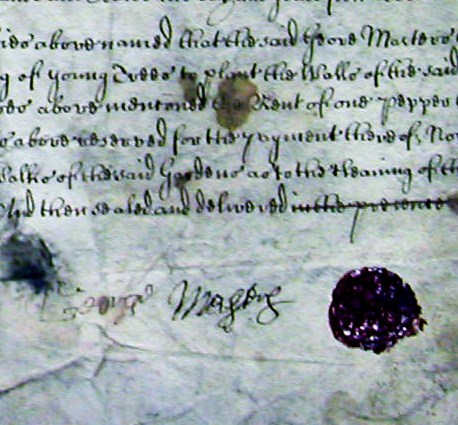
George Masters of Strand on the Green died in March 1734 and in May a public notary assisted his widowed sister, Rebecca Clements, to prepare an inventory of his property. The document lists his furnishings and utensils, in seven rooms and a yard, followed by his nursery stock, tools and equipment. While the house was relatively sparsely furnished, his gardens were bursting with plants.
In the “seed rooms and other lofts” were old clothing, linen and lumber but no seeds, though bushells of peas and beans were listed elsewhere. The detail of the inventory is valuable in showing the range of plants Masters grew, mixing trees, shrubs and hedging plants with orchard trees and plants for the flower garden.
John Harvey found Masters’ name as one of the gardeners who prepared a similar inventory following the death of William Cox of Kew in 1722. Batty Langley, the son of a Twickenham gardener, wrote in New Principles of Gardening in 1728 that Cox was an improver of early peas, a variety “known by the name of Master’s Hots, first raised and improved by an ingenious Gardener and Nursery Man of that name now living in Strand on the Green near Old Brentford”.
Peas were popular in the early 18th century and Masters’ inventory lists six bushells of Hotspur Peas and a further bushell of dwarf peas at 5 shillings a bushell, as well as 12 bushells of garden beans at 2 shillings a bushell, relatively modest quantities. The gardens were not planted with peas for seed when he died. In comparison, John Brooks, a neighbour, bequeathed to his son by his July 1723 will “seven cows & two heifers, seven hoggs, my seed peases worth forty pounds and his mothers books”. At 1734 prices this represents between 135 and 160 bushells of peas.
Chiswick Local Studies Collection
The inventory describes eleven plots, five on leases and one of these in Acton. More research is needed to confirm their locations but other evidence suggests that most were at London Stile, between today’s Kew Bridge and the High Road junction with Wellesley Road. These garden plots lay among many others in the triangle of rising ground between the riverside village of Strand on the Green on the west, the road to the west on north and Sutton Lane/Fauconberg Road and Grove Park Terrace to the south east (all London W4 today).
On his 1746 map of London & Environs Rocque shows the gardens with parallel rows of planting, sometimes in squares, and enclosed within walls or hedges to shelter them from the winds which whip across the flat land beside the river. The area was well placed for road and river transport and near to the Brentford & Kew Ferries.
In the “Garden next the Road Walled Round with Bricks” were flowers – six beds of anemones, 5,000 ranunculus, 44 cyclamen, 20 scarlet lichen, 24 double lady smocks, 12 peach-coloured hepaticas at a penny each and four blue at 6 pence each, along with 1,000 small yews and a few large hollies. In “the Great Garden Ground” were 200 striped lilies at three pence each, four thousand jonquils, 1500 Persian Iris at 2 shillings a hundred, 4 beds of double peonies and 600 fraxaneias.
The next three plots have trees, shrubs and hedging plants in large quantities. There were 10,000 quick (small cuttings of hawthorn or hazel) at 3 shillings a thousand, 600 “hedge yews at 3 foot high” at 10 shillings a hundred, 800 small seedling yews, standard elms, 24 roses at a penny each and 100 “lealocks” (lilacs) worth 15 shillings. In addition there were fruit trees: 200 plum stocks, 500 codling stocks and “pairs” (pears), 200 gooseberry plants, 100 redcurrants and 25 mulberry trees.
The “Upper Quarter next the Wall” housed some plants, the stock of seed peas and beans, and a great deal of equipment. Besides 600 horse chestnuts and 100 English chestnuts together worth £1 and 2,000 honeysuckles worth £5, there were plots of roses, standard elms, and “a parcel of small Orange Stocks in Potts and the Potts” worth 15 shillings.
The equipment included 11 lights for cucumber frames containing about 150 feet of glass at 3d a foot, 48 glasses for melons at 8d a glass, about a thousand paving bricks, 236 sieves and 22 half sieves (market baskets usually in bushell and half-bushell sizes), 16 maunds (baskets with handles), three barges (barrows without wheels), two hand-barrows, four garden ladders, a pair of steps, a harrow and a roller, a drill plough, a swing plough, 100 small garden pots, a water barrow and tub and four watering pots. All of the gardeners must have used large numbers of flower pots and these, together with other useful clay items like weights for fishermen’s nets, were probably made only yards upstream at Mr Trimmer’s brick tile works, or at the pottery in Brentford.
Detail from A Survey of Ealing Parish of 1777
The plot of land in Acton, leased from William Goodwin, held 800 elms at 10 shillings a hundred, 2,000 hornbeams at £5 a thousand and 500 beeches at 10 shillings a hundred. Though it lay in a neighbouring parish, Goodwin’s land was only a short distance eastwards near Turnham Green, on the opposite side of the road from the other plots held by Masters at London Stile, as the map shows.
On 2 acres at Strand on the Green, leased from John Pennar, were 100 pear trees, 25 double flowering whitethorn, 24 single flowering pomegranates, 150 Spanish chestnuts, 100 gooseberry plants, 1,700 small bays, four thousand yews 4 feet high worth £20, 200 grafted plum trees and plots of elm and yew trees. John Pennar or Pinner was a local carpenter who had been admitted to 3 acres of land and five cottages in 1707. In May 1734, after Masters’ death, Pennar surrendered them in the manor court to another gardener, William Compton, one of the heirs of Nicholas Parker.
As George Masters seems not to have left a will we have no details of family bequests or friends who were witnesses. He would certainly have needed labour in his gardens but we have no information about his workforce. However, the family can be reconstructed from other sources. The George who died in 1734 was the son and grandson of men of the same name. The burial of his mother Martha, in 1702, appears in the parish register with a note that she was the wife of George Masters, gardener, confirming that at least two generations were engaged in the gardening trade.
In 1685/6 a George Masters of Chiswick took an 8-year lease on the gardens of Holland House in Kensington, described as the Great Garden and the Kitchen Garden, from Viscount Dunkellin and the Countess of Warwick. He was to cultivate and maintain these gardens, and could house a “servant” in one of the lodges, but he must also allow the family of the aristocratic owners to continue to enjoy the gardens.
It is likely that this George Masters was “our” George’s father, who died in 1707. He was listed in the rate books at the fourth property from the south west end of Strand on the Green in the 1680s, with his father at London Stile from the 1670s. The parish rate books show “our” George signing his name as a vestry member in 1719. He took on his father’s property with the garden ground at Strand on the Green still valued at £24, while his brother Richard was listed 30th from the south west with a house worth £3. Their cousin, Thomas Masters, was at Little Sutton, with property worth £25, where another plot worth £30 was held by Masters and West. Given the huge difference in valuation, it is possible that Richard is rated only for a house and might have worked with George on the family gardens.
Rebecca Clements, born in 1681, married Richard Clements, from a large Isleworth gardening family, in 1708; she was widowed by March 1734 when she prepared her brother’s inventory. August 1734 saw two weddings – George’s daughter, Elizabeth, married Philip Clements while Rebecca married Rice Lewis, gardener to Lord Burlington at Chiswick House. (J H Harvey records that Lewis was one of the prominent gardeners who subscribed to Philip Miller’s Gardener’sDictionary of 1731.) Rebecca made her will in 1735, describing herself as a gardener. In it she dealt with her own estate from the settlement made at her marriage to Lewis. Her sister Catherine’s husband, Thomas Couchman, a distiller with property in the City of London and on Strand on the Green, was a trustee of the settlement.
When Luke Wetten, the royal confectioner, acquired a house nearby with 6 acres of orchard and gardens in 1772, and a further 4.5 acres of adjoining land in 1774, both properties were said to have been “heretofore occupied” by George Masters. His relationship to “our” George is not yet clear. The court rolls record that the same property was let to Mr Zoffany, the artist, during 1764-1772. This was probably the adjoining Sydney House rather than London Stile House, but a Masters clearly worked most of the garden ground there.