The Murfin family

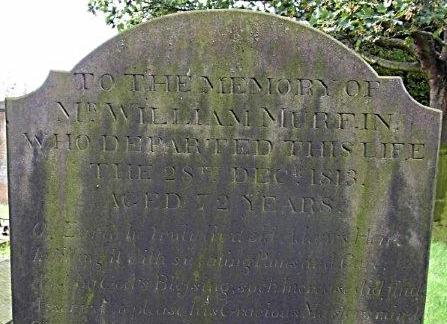
By chance I found the headstone on William Murfin’s grave at St Nicholas, Chiswick. I had already discovered his will, but it threw up a question to which the inscription on this headstone provides the answer.

William Murfin (1741-1813) was head gardener at Chiswick House by 1790 and worked for Georgiana, Duchess of Devonshire, on her Ladies Garden and Pleasure Garden. Trained by Robert Teesdale Senr at Castle Howard, he was recommended for the Chiswick post by the Duke of Portland’s gardener at Welbeck. Murfin’s name appears as witness to the will of a fellow servant in the Devonshire household, Mary Griffiths, in August 1797. He left his Chiswick House post in the winter of 1811/12 when his salary was listed as £60. His name is crossed out in the accounts, with ‘Robert Clues’ written in above – he was to receive £100 a year. By the time of his death at 72, in December 1813, William Murfin had retired to Turnham Green.

His tomb stone carries this verse:

On Earth he truly liv’d old Adam’s heir,
In tilling it with sweating Pains and Care:
And by God’s blessing such increase did find
As served to please his Gracious Master’s mind,
Till from those Earthly gardens he did Rise
Transplanted to the upper Paradise

William Murfin still described himself as ‘gardener’ when he wrote his will in 1813. He was prosperous enough to make bequests involving over £3,200-worth of Bank of England stock which included:

• income and dividends from Bank of England Stock to his good friend Ann Venables of Turnham Green, spinster, for her natural life
• £300 capital stock to his sister Eleanor and her husband William Poyser
• £300 capital stock to his sister Joice, widow of George Clews
• £100 capital stock to his niece Elizabeth Horne, wife of William, carpenter of Whetstone, Middlesex
• £500 to William Murfin, son of my cousin William Murfin, of Bradley, Derbyshire, grocer
• £50 capital stock for her own use to Mrs Anne Allnutt, wife of William Allnutt, of Piccadilly, Middlesex, turner and
• £2,000 of capital stock transferred to cousin William Murfin the elder

The will confirms that his family came from parishes on the Staffordshire/Derbyshire border. Our William’s father was almost certainly the William born in 1716 in Bradley, Derbyshire, whose wife was Ellen; William Murfin the elder died on 5 August 1792 and was buried in Doveridge, also in Derbyshire. His two sisters married local farmers – Eleanor’s husband was William Poyser of Swincoat in Blore, Staffs and Joice married George Clews of Marchington, Staffs.

The Chiswick William Murfin makes no mention of a wife or children in his will, though a John Murfin was buried at St Nicholas in July 1791, around the time that William came to work in Chiswick. (There are only three mentions of the surname in the registers). However, he may have had a son also called William Murfin; the parish registers of St Cuthbert’s, Ackworth, just south of Wakefield, record the baptism of a son of that name to William Murfin, gardener and his wife Sarah, at Low Town, in 1772.

William’s Clews nephews
William bequeathed his ‘stock’ (mentioned separately from Bank of England stock) to his two Clews nephews. Since both were gardeners this must refer to garden stock at Turnham Green where he might have been running a nursery after his retirement from the Chiswick House estate.  In his will William describes his nephew Robert Clews as “gardener to his Grace the Duke of Devonshire at Chiswick” and Robert’s brother, Thomas, as “gardener to Rt Hon Lord Bradford at Weston Hall, Staffs”. Robert had taken over from William Murfin at Chiswick on Lady Day 1812 at £100 a year. In addition to the garden stock the nephews were to have the residue; Robert was one of three executors along with William Allnutt and Richard Williams (of the Chiswick Nursery).

The will of Robert Murfin, our William’s brother, suggests that he had a hand in training the next generation. Robert Murfin was gardener at Saltram in Devon; he was ill and died shortly after making his will in August 1798. The owner of the Saltram estate bemoaned his loss in a letter to to a friend, wondering how she was going to replace him. He made his brother his executor and left him the residue of his estate. His main bequest was £600 in 5% bank stock to his three sisters. He left £50 to one of the garden workers, £20 to a godson and £10 to his nephew Robert Clews, ‘labourer at Saltram’, who was working alongside him.

No record has been found of a marriage involving Thomas Clews at Chiswick. However, the parish registers record the baptism on 13 March 1808 of a baby boy born on 9 January 1808. The entry names him as Thomas Clues Murphin, the son of Thomas Clues and Martha Kerrison, and he may have been illegitimate. Perhaps the addition of the second surname of Murfin indicates that William had taken his nephew’s child under his wing. No further record of Thomas Clews Murfin occurs in the Chiswick registers and he is not mentioned in William’s will. A Thomas  Clews, farmer, aged 55, is listed in the 1841 Census at Weston Mill Farm near Weston Hall with his wife and three children; perhaps he had become a farmer in his own right after gardening at Weston Hall.

No marriage or burial record has been traced for Robert Clews. However, he has nevertheless left us a significant legacy for as head gardener he must have overseen the major works on the former Morton Hall estate to the east of Burlington’s garden, acquired by the 6th Duke of Devonshire in 1812 – these created the Italian Garden and the long conservatory with gardeners’ bothies behind, and took in the walled gardens to the north. The scale of the works can be judged by a report in The Morning Chronicle on 19 November 1812 which stated that 150 men had been employed in the gardens for the previous six months. He played a part in the Horticultural Society’s gardens (the predecessor of RHS Wisley today) which lay just north of the Chiswick House estate and was made a Fellow of the Society, a sign that he was held in some esteem by his peers. In 1823 he exhibited there a number of varieties of grapes and in 1830 two varieties of apple named after him. He also appeared in the 1830 subscription list to support the Horticultural Society’s garden, contributing five shillings.

Resolving the puzzle
The question posed by William Murfin’s will is who was his ‘good friend’, Ann Venables? Only one other Venables appears in the parish registers at this period; a ‘Robert Venable’ was buried at St Nicholas in January 1779 but there is no evidence that he was related to her. Ann’s will reveals more. There she described herself as ‘spinster’ of Turnham Green, whereas Murfin had called her ‘spinster and servant maid’. The Chatsworth Servants’ Database reveals that she was the Housekeeper, a very senior “servantmaid” indeed, from at least 1774. Her request in the will to be buried in the same grave as her late friend Mr William Murfin raised the second question – was this carried out? She died, aged 72, in December 1814 and we know that her request was fulfilled because her executors added an inscription to William’s headstone which confirms that they were together. They were most probably a couple but unmarried.

Ann left specific furniture and silverware as well as the residue and the funds in the Bank of England to William Murfin’s nephews. As well as a selection of silver cutlery, Robert was to have the white bed furniture and bedding in the white bedroom, a bureau with drawers, chairs and a washstand. Thomas Clews received Anne’s own bedroom furniture, including a mahogany wardrobe, and she left her gold watch to Thomas’s wife.  The home sounds as if it is furnished with some taste. Ann did not specify the post of Thomas Clews, but referred to Robert as the Duke of Devonshire’s gardener. Robert was to be one of her executors along with William Allnutt.

According to the will and insurance records Allnutt was a wood turner at 186 Piccadilly. He lived to be over 90 and appears in the 1841 census, next door to the Blackmore family  in Stamford Brook (in the north-east corner of Chiswick Parish). Susannah Blackmore and Ann Robarts (living in the house left to them by their father William Blackmore) were also beneficiaries – amongst Ann’s bequests to them was a leather trunk with the initials GR, possibly originally from the royal household. William Murfin had been a witness to the will of their father, William Blackmore, proved in 1799.One other gardener in this circle knew the Blackmores well. Robert Teesdale jnr, who died at Christmas 1804, had lived in Turnham Green since the early 1790s.  Two of the witnesses to his will were Susannah Blackmore and her sister Ann.

Some of Ann Venables’ own relatives and neighbours are also mentioned. Ann left money, elegant garments and china ornaments from her bedroom mantelpiece to her cousin, the wife of a vicar in Bengeo in Hertfordshire. Her best clothing was to go to Esther Allnutt, wife of William, one of her executors, and her ‘worst clothing’ was to go to her servant along with £5. The presence of a servant for a woman only recently described as a servant maid herself says something of her status.

So William may have been widowed by the time he came to Chiswick House, certainly had a close relationship with Ann Venables, who was buried with him, and lived in some comfort. He seems to have continued gardening after his nephew took over from him at Chiswick, and had close friends at Turnham Green and Stamford Brook. The links to different estates in England for this one gardening family alone, show how experienced garden specialists were recruited by land owners and moved from one end of the country to the other.

Sources of information

• Chatsworth archives, ms L114/51, Household Establishments No 2, Chiswick Establishment, 25 December 1811. Information from Peter Hammond, 22.05.2014
• Will of Robert Teesdale 1740-1804, PROB 11/1420; described as ‘of Hammersmith’ in will, he lived at Turnham Green in Chiswick Parish by 1790, with his wife Britannia and 3 sons
• Details of early career from David Jacques’ research on Chiswick House gardens, 1980s
• Will of William Murfin TNA PROB 11/1551
• Robert Clews’ grapes, reported in Journal of Science and the Arts vol 15 1823 and apples reported in J C Loudon Gardeners Magazine vol 6 1830
• Will of Robert Murfin, TNA PROB 11/1312
• Will of Ann Venables TNA PROB 11/1579
• Will of William Blackmore TNA PROB 11/1319
• Robert Teesdale’s will, PROB 11/1420
• Letter from Anne Robinson of Saltram, 30 August 1798 PWDRO 1259/2/399
• Bill from Robert Murfin for trees and garden work at Saltram, 1791-3, PWDRO 1259/5/22

The Middlemists

Who was John Middlemist, the gardener responsible for the camellia Middlemist’s Red? This bloomed in March 2010 in the newly-restored conservatory at Chiswick House and made the national press.

In March 2010  Middlemist’s Red camellia bloomed in the newly-restored conservatory at Chiswick House. Probably introduced in 1808, it is such a rarity 200 years later that the flowers appeared in the national press and on TV; only one other plant is believed to exist, in Waitangi, New Zealand.

Of all the names in my list of gardeners in Chiswick and nearby parishes, there was no mention of a Middlemist. Eleanor J Willson’s book, Nurserymen of Hammersmith & Fulham (1982), came to the rescue. She states that John Middlemist of Bryanston Street, Kensington, and Alexander Wood of Roehampton, created the Cape Nursery on 13 acres of arable land on the south side of Shepherds Bush Green.  They specialised in pelargoniums, camellias and dahlias and by 1802, had a good reputation for their flowering plants.

Middlemist had apparently spent time in South Africa – hence the name of the nursery – and at least some of his stock must have been raised from seed that he collected or which was supplied by contacts abroad.  Middlemist was running the nursery alone in 1822 but by 1834 part of it had been taken over by William Plimley, a nurseryman and another part was being let for building.

Children of John and Elizabeth Middlemist were baptised in Hammersmith in 1814/5 but I have not yet traced a will for John Middlemist. The National Archives holds wills for Walter Middlemist and William Middlemist, however, revealing that both of them were gardeners in Twickenham.  The relationship between these two is not yet clear – they may have been brothers – but they clearly come from a Scottish family. Walter’s will mentions his sister, Ann Scott, in Edinburgh; at her marriage in 1749 she is recorded as the daughter of Gilbert Middlemist, another gardener. William made a bequest to his brother’s children in Roxburghshire.

Many of those gardening in Middlesex during this period had come to London after the Act of Union of 1707 in search of work. Amongst them were Henry Scott, Lord Burlington’s gardener in the 1730s, his brother James, who ran a specialist nursery at Turnham Green and the Ronalds family who ran a substantial nursery business in Brentford from the 1740s.

Walter Middlemist was gardener to Mr Hindley, at Radnor House in Twickenham. When he died in 1780 Walter left his box of possessions, including books and a watch, to ‘William Middlemiss’, though he did not state his relationship to William in his will. Surprisingly since he had books, he made his mark, rather than signing his will – it is possible he was too ill to sign. Thoughtfully he left his clothes to his two staff at Radnor House, Sims Clarke and John Bridgewater.

William was gardener to John Briscoe, at Cross Deep House, a short distance upstream of Radnor House, close to Strawberry Hill; he nominated Briscoe as one of his executors. The other executor was John Middlemist, whom he described as his half-brother and to whom he left over £100 in 5% Bank of England stocks. As William was buried in Hammersmith Parish in 1804, where John’s children had been baptised and his family presumably lived and worked, this seems to confirm the connection between him and the Twickenham Middlemists.

References:  Walter Middlemist’s will PROB 11/1066; William Middlemist’s will PROB 11/ 1416 (both National Archives); burials, baptisms from parish registers indexed on ancestry.co.uk.

Nicholas Parker

Nicholas Parker was a wealthy gardener who lived on Strand on the Green. After his death in 1726, his bequests to Henry Woodman and his future wife Eleanor Compton, and to other members of the Compton family, ensured the continuation of the garden grounds in skilled hands.

Nicholas Parker

The accounts kept by the Earl of Fauconberg’s steward, Arthur Palmer, record substantial expenditure on the Earl’s new gardens at Sutton Court, Chiswick between 1685 and 1700. The name of Nicholas Parker recurs regularly in Palmer’s account book. Parker supplied plants, sometimes in large quantities, for the Sutton Court garden. Almost all of the payments made to Nicholas Parker or Mr Parker are for the supply of “trees” with only one entry for “plants”. A few entries are more specific, listing “ew”, 300 hornbeams and 38 phillireas, and in 1685 alone Mr Parker was paid the substantial sum of £17 for fruit trees. Separately, “Goodman Parker” appears against payments of £19.2s and £50 for carpentry, with a further £17 for “digging and wharfing a new pond”.  It is probable that Goodman Parker was Nicholas Senior, father to the gardener.

So far it has not been possible to identify exactly where all of the Parkers’ properties lay.  Nicholas Parker Senior appears in the rate books on Strand on the Green from around 1660; he signed his name as a member of the vestry in 1675 and died in December 1714. Nicholas Parker Junior was not rated identifiably by that name until about 1690. In 1699 he served as churchwarden and in 1709 made a donation of £1 towards work on the north aisle of the parish church. By 1719 he is paying rates on property worth £38 and land in Sutton Field worth £16, almost certainly having taken over land which his father occupied.

Given the quantities of trees supplied to Fauconberg, Nicholas Parker was already a substantial nurseryman by the 1680s, though he does not appear in Harvey’s very comprehensive book, Early Nurserymen. Fortunately a will of June 1725 made by Nicholas Parker of Strand on the Green, “Gardiner”, has survived. In it he requested that he should be buried near his late father at St Nicholas Church, Chiswick.

Though no reference is made in the will to a wife, he seems to have been married twice. His first wife, Elizabeth, was buried in 1688 at St Nicholas; on 11 December 1693 the marriage is recorded between Nicholas Parker, gent, widower, and Mrs Jane Goodwin, widow, by Canterbury licence.

From the lists of Chiswick burials, she may have been the widow of Henry Goodwin, buried in linen in 1687/8, or of another Henry Goodwin buried in 1690. The wealthiest of the Goodwins was living at Sutton Court in 1719. And there were Goodwins who were gardeners, who owned land north of Chiswick High Road, near today’s Chiswick roundabout. There were  Brentford Goodwins as well, including a basket-maker.

In 1709 Nicholas Parker Junior is named by George Warner of Turnham Green as one of two executors “which I esteem as my loving friends”. Parker’s social status as a gentleman is further confirmed by his own “good friends” mentioned in the will. He leaves a guinea each for mourning rings for Mr Thomas and Mr George Barker and appoints another, Thomas Mawson, as executor. The Barkers had owned The Grove estate in Chiswick since the middle ages and its land adjoined Vernon Cottage. Mawson had property on the Strand and owned the brewery which was the predecessor of today’s Griffin Brewery. His family was also comfortably off, and one of his brothers was Bishop of Chichester.

Parker’s bequests reveal him to be a man of property with copyhold houses and land in Turnham Green, Little Sutton and Strand on the Green, held of the manor of Sutton Court, and two freeholds in Catherine Wheel Yard, New Brentford. The freeholds secured the right to vote, and a Nicholas Parker is listed in the 1710 Middlesex Poll Book. At this date Nicholas Parker Senior was still alive so these properties may have come to our gardener as a bequest from his father. The will also includes two properties at Strand on the Green, one with six acres and the other with half an acre of land which Parker occupied himself.

William Compton, Parker’s “kinsman” and one of his executors, inherited most of the property, including a house with five and a half acres of gardens at the downstream end of Strand on the Green, then let to Joseph Miller, the comic actor. Miller leased this house, later named Vernon Cottage,  from 1686 to his death in 1738.  And when Nicholas Compton died in 1760, describing himself as gardener in his will, he bequeathed a house with five and a half acres of gardens which he himself occupied, confirming that this was the house he had inherited. Vernon Cottage is clearly labelled on Leigh’s 1831 Panorama of the Thames, just downstream of the Strand, with a walled garden and at least one glasshouse. William Compton took on responsibility for his brother Nicholas’ five daughters and later left garden grounds to the oldest of them in his own will.

Along with £5 for the poor of Strand on the Green, Parker’s will provided  annuities for various relatives as well as bequests of £50, £100 or £200 to a number of friends and relatives:  Elizabeth Parker “now living with me”, Mary and Ellen Parker, William Goodwin of Shepperton, Thomas Goodwin of Laleham, Katharine and Eleanor Compton of Turnham Green. Parker often uses the word “kinsman” to describe these heirs, suggesting that they may have been his wives’ relations rather than his blood relatives. William Compton’s will reveals that Katharine and Eleanor were the sisters of himself and Nicholas Compton.

The Masters family

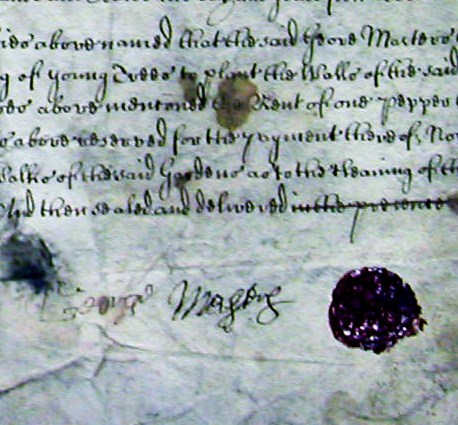
Several generations of the Masters family, including women gardeners, cultivated garden grounds in Strand on the Green and London Stile in Chiswick and Acton parishes in the 17th and 18th centuries.

George Masters of Strand on the Green died in March 1734 and in May a public notary assisted his widowed sister, Rebecca Clements, to prepare an inventory of his property. The document lists his furnishings and utensils, in seven rooms and a yard, followed by his nursery stock, tools and equipment. While the house was relatively sparsely furnished, his gardens were bursting with plants.

In the “seed rooms and other lofts” were old clothing, linen and lumber but no seeds, though bushells of peas and beans were listed elsewhere. The detail of the inventory is valuable in showing the range of plants Masters grew, mixing trees, shrubs and hedging plants with orchard trees and plants for the flower garden.

John Harvey found Masters’ name as one of the gardeners who prepared a similar inventory following the death of William Cox of Kew in 1722. Batty Langley, the son of a Twickenham gardener, wrote in New Principles of Gardening in 1728 that Cox was an improver of early peas, a variety “known by the name of Master’s Hots, first raised and improved by an ingenious Gardener and Nursery Man of that name now living in Strand on the Green near Old Brentford”.

Peas were popular in the early 18th century and Masters’ inventory lists six bushells of Hotspur Peas and a further bushell of dwarf peas at 5 shillings a bushell, as well as 12 bushells of garden beans at 2 shillings a bushell, relatively modest quantities. The gardens were not planted with peas for seed when he died. In comparison, John Brooks, a neighbour, bequeathed to his son by his July 1723 will “seven cows & two heifers, seven hoggs, my seed peases worth forty pounds and his mothers books”. At 1734 prices this represents between 135 and 160 bushells of peas.

Chiswick Local Studies Collection

The inventory describes eleven plots, five on leases and one of these in Acton. More research is needed to confirm their locations but other evidence suggests that most were at London Stile, between today’s Kew Bridge and the High Road junction with Wellesley Road. These garden plots lay among many others in the triangle of rising ground between the riverside village of Strand on the Green on the west, the  road to the west on north and Sutton Lane/Fauconberg Road and Grove Park Terrace to the south east (all London W4 today).

On his 1746 map of London & Environs Rocque shows the gardens with parallel rows of planting, sometimes in squares, and enclosed within walls or hedges to shelter them from the winds which whip across the flat land beside the river. The area was well placed for road and river transport and near to the Brentford & Kew Ferries.

In the “Garden next the Road Walled Round with Bricks” were flowers – six beds of anemones, 5,000 ranunculus, 44 cyclamen, 20 scarlet lichen, 24 double lady smocks, 12 peach-coloured hepaticas at a penny each and four blue at 6 pence each, along with 1,000 small yews and a few large hollies. In “the Great Garden Ground” were 200 striped lilies at three pence each, four thousand jonquils, 1500 Persian Iris at 2 shillings a hundred, 4 beds of double peonies and 600 fraxaneias.

The next three plots have trees, shrubs and hedging plants in large quantities. There were 10,000 quick (small cuttings of hawthorn or hazel) at 3 shillings a thousand, 600 “hedge yews at 3 foot high” at 10 shillings a hundred, 800 small seedling yews, standard elms, 24 roses at a penny each and 100 “lealocks” (lilacs) worth 15 shillings. In addition there were fruit trees: 200 plum stocks, 500 codling stocks and “pairs” (pears), 200 gooseberry plants, 100 redcurrants and 25 mulberry trees.

The “Upper Quarter next the Wall” housed some plants, the stock of seed peas and beans, and a great deal of equipment.  Besides 600 horse chestnuts and 100 English chestnuts together worth £1 and 2,000 honeysuckles worth £5, there were plots of roses, standard elms, and “a parcel of small Orange Stocks in Potts and the Potts” worth 15 shillings.

The equipment included 11 lights for cucumber frames containing about 150 feet of glass at 3d a foot, 48 glasses for melons at 8d a glass, about a thousand paving bricks, 236 sieves and 22 half sieves (market baskets usually in bushell and half-bushell sizes), 16 maunds (baskets with handles), three barges (barrows without wheels), two hand-barrows, four garden ladders, a pair of steps, a harrow and a roller, a drill plough, a swing plough, 100 small garden pots, a water barrow and tub and four watering pots. All of the gardeners must have used large numbers of flower pots and these, together with other useful clay items like weights for fishermen’s nets, were probably made only yards upstream at Mr Trimmer’s brick tile works, or at the pottery in Brentford.

Survey of Ealing Parish 1777
Detail from A Survey of Ealing Parish of 1777

The plot of land in Acton, leased from William Goodwin, held 800 elms at 10 shillings a hundred, 2,000 hornbeams at £5 a thousand and 500 beeches at 10 shillings a hundred. Though it lay in a neighbouring parish, Goodwin’s land was only a short distance eastwards near Turnham Green, on the opposite side of the road from the other plots held by Masters at London Stile, as the map shows.

On 2 acres at Strand on the Green, leased from John Pennar, were 100 pear trees, 25 double flowering whitethorn, 24 single flowering pomegranates, 150 Spanish chestnuts, 100 gooseberry plants, 1,700 small bays, four thousand yews 4 feet high worth £20, 200 grafted plum trees and plots of elm and yew trees. John Pennar or Pinner was a local carpenter who had been admitted to 3 acres of land and five cottages in 1707. In May 1734, after Masters’ death, Pennar surrendered them in the manor court to another gardener, William Compton, one of the heirs of Nicholas Parker.

As George Masters seems not to have left a will we have no details of family bequests or friends who were witnesses. He would certainly have needed labour in his gardens but we have no information about his workforce. However, the family can be reconstructed from other sources. The George who died in 1734 was the son and grandson of men of the same name. The burial of his mother Martha, in 1702, appears in the parish register with a note that she was the wife of George Masters, gardener, confirming that at least two generations were engaged in the gardening trade.

In 1685/6 a George Masters of Chiswick took an 8-year lease on the gardens of Holland House in Kensington, described as the Great Garden and the Kitchen Garden, from Viscount Dunkellin and the Countess of Warwick. He was to cultivate and maintain these gardens, and could house a “servant” in one of the lodges, but he must also allow the family of the aristocratic owners to continue to enjoy the gardens.

It is likely that this George Masters was “our” George’s father, who died in 1707. He was listed in the rate books at the fourth property from the south west end of Strand on the Green in the 1680s, with his father at London Stile from the 1670s. The parish rate books show “our” George signing his name as a vestry member in 1719. He took on his father’s property with the garden ground at Strand on the Green still valued at £24, while his brother Richard was listed 30th from the south west with a house worth £3. Their cousin, Thomas Masters, was at Little Sutton, with property worth £25, where another plot worth £30 was held by Masters and West. Given the huge difference in valuation, it is possible that Richard is rated only for a house and might have worked with George on the family gardens.

Rebecca Clements, born in 1681, married Richard Clements, from a large Isleworth gardening family, in 1708; she was widowed by March 1734 when she prepared her brother’s inventory. August 1734 saw two weddings – George’s daughter, Elizabeth, married Philip Clements while Rebecca married Rice Lewis, gardener to Lord Burlington at Chiswick House. (J H Harvey records that Lewis was one of the prominent gardeners who subscribed to Philip Miller’s Gardener’s Dictionary of 1731.) Rebecca made her will in 1735, describing herself as a gardener. In it she dealt with her own estate from the settlement made at her marriage to Lewis. Her sister Catherine’s husband, Thomas Couchman, a distiller with property in the City of London and on Strand on the Green, was a trustee of the settlement.

When Luke Wetten, the royal confectioner, acquired a house nearby with 6 acres of orchard and gardens in 1772, and a further 4.5 acres of adjoining land in 1774, both properties were said to have been “heretofore occupied”  by George Masters. His relationship to “our” George is not yet clear. The court rolls record that the same property was let to Mr Zoffany, the artist, during 1764-1772. This was probably the adjoining Sydney House rather than London Stile House, but a Masters clearly worked most of the garden ground there.

MASTERS FAMILY TREE