William Hogarth’s garden

Stepping through the gate in the wall around Hogarth’s House in Chiswick, you leave behind six lanes of roaring traffic. It really does feel like stepping back into the past, even when planes are flying in every 90 seconds towards Heathrow on a warm summer’s day.

T M Rooke's view of the House from the lane; John Allgrove's signboard is fixed to the wall (Hounslow Local Studies)

The House re-opened in November 2011 following a major refurbishment over the previous 4 years. Following a good deal of new research it has been possible to create a new presentation of the House. In the years before it closed for the refurbishment, trustees and volunteers asked visitors to the House what would make a visit more enjoyable. We were especially interested in the response of those who had come for the first time or returned after a long gap because of a special event. There were two strong messages from these discussions. First, they wanted to make sense of Hogarth’s House as a home and, secondly, they wanted to know who else had lived there before and after the Hogarths. Rather than continuing the past practice of using it as a gallery with serried ranks of Hogarth’s prints in black frames, the new presentation  reveals the Hogarth household using the House as their second home, away from the noise of Leicester Fields, and tells the stories of their lives, provides information about their friends and neighbours and also reveals the fascinating residents who came before and after them.

It was not, however, part of the plan to refurbish the garden within this project. The double gates at the bottom of the garden have been restored and given back their spherical finials (found in the shrubbery!), and the path from there to the House now provides level access from the pavement outside. This follows the line of a path on the 1865 OS map. But replanting and dealing with the sycamore seedlings in neglected areas has to wait for the time being. My research into the garden in the past will help guide appropriate planting in the future. So what do we know?

The plot was an orchard, probably from the 1670s. It was enclosed from Chiswick’s Common Field by the Downes family who were millers and bakers; they appear int he parish accounts  supplying communion bread to St Nicholas Church. Susannah Downes left the plot to one of her sons in 1713 and the new house was completed by 1717. In 1749 the Hogarths bought it from the son of the first occupant, Lutheran Pastor Georg Andreas Ruperti. His substantial library was sold over 8 evenings in 1732 and pleasingly included some gardening books.

The present garden is a distorted triangle and it was already that shape by the time of the first large scale Ordnance Survey in the 1860s. But on John Rocque’s 1745 Survey of London and Environs, there is clearly a rectangular plot. John Philips, a nephew of Mrs Hogarth and her cousin, Mary Lewis, kept a small collection of Hogarth mementoes and wrote notes to go with them. These items and the notes have found their way into Aberdeen City Art Gallery’s collection.

One note reads, ‘In 1759 Mr H increased the size of his garden by taking a lease for 21 years of 264 square foot from the Earl of Morton which made his garden square – The said pce forming two sides of a plain triangle.’ If this was a renewal of a previous lease it may explain the Rocque image for Morton House was next door to the west. [Built by Sir Stephen Fox in 1682-3 Morton House still stood when the property was acquired by the 6th Duke of Devonshire in 1812 in order to extend the grounds of Chiswick House. There he built the conservatory and employed Lewis Kennedy to lay out the Italian Garden; to the north of this three of Fox’s four walled gardens survive.]

It is not possible to recreate Hogarth’s rectangular garden as later developments – most of them aggressively inappropriate offices and industrial structures for the curtilage of a  Grade 1 listed house – crowd up against the walls today. However, there is some evidence that the core of the garden’s structure remains.

Detail from Hogarth's view, his house shown in shade.

Hogarth’s own sketch of his House, seen from Chiswick Common Field to the north, was published as a print by his widow in 1782. Tall trees seem to follow the line of the far boundary and the western wall of the garden, with lower fruit trees in front of them. The long wall facing the lane with a gate near the House can be seen. At the bottom of the garden (on the right/west) is a double door giving access to Hogarth’s small carriage house and/or stable with a room above – one of John Phillips’ notes against the print in a scrap book confirms that this was the “paintin room”. The studio was pulled down in the 1870s but a double gate remains here.

Hogarth's House in the 1880s. The mulberry is the largest tree, with a fan trained fruit tree on the wall to the left and two plum trees which survived until the 1930s to the right (Hounslow Local Studies)

The Hogarths would have known the old mulberry tree in his garden, and there are stories that Mrs Hogarth made mulberry pies for foundling children who were visiting them. The tree may date from the original orchard; it has survived bomb damage and old age and gave a good crop of fruit this year, some of which was used in small pies at the re-opening of the House. Most houses of this size would have had a vegetable plot growing pot herbs for the kitchen and Hogarth also had a nut walk where he enjoyed playing ninepins with his friends.

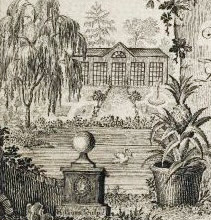
We know nothing about a flower garden here in the Hogarth’s time. However, Mary Lewis’s brother John, a flautist who was related by marriage to the Clitherows of Boston Manor, lived in The Butts in Brentford. Amongst his neighbours was the Swinden family and it is interesting to imagine that Lewises and Swindens knew each other sufficiently well for Mary Lewis to have bought seeds for her garden at Chiswick from Swinden’s catalogue. We may be able to plant some of his flower garden schemes in the future.

When the long connection of Hogarth relatives and friends came to an end in 1813 the House was put up for sale. The newspaper advertisement describes the garden.

Morning Chronicle 29 April 1814

From the mid 19th century the House was occupied by a variety of tenants. In about 1870 a nursery gardener called Coles was working the garden and his family shared the House with Alice Clack, who kept pigs. After Alfred Dawson restored the House in the early 1890s he let it to John Allgrove, described as a florist, who ran the Hogarth’s House Nursery there. Dawson also let to Allgrove part of the garden of his family’s home, The Cedars, which adjoined that of Hogarth’s House to the south.

John Allgrove with his wife in the garden (Hounslow Local Studies)

The House was purchased in 1901 by Lieut Col Shipway, who made it his personal project. He took specialist advice from Frederick W Peel, architect, and Austin Dobson, then Hogarth’s most recent biographer. He restored the building, made a collection of Hogarth prints and commissioned chairs and tables based on pieces in Hogarth’s works from the Chiswick Art-Workers’ Guild. He even took the photographs for the 1904 guide book.

Jessie Macgregor's 1913 sketch of the garden

The influence of the arts and crafts movement is clear in the garden; having been a nursery garden until Shipway purchased it, some replanting must have taken place during the restoration. The long path from the House to the bottom of the garden was retained, and still survives, and the bed by the wall was planted with purple irises behind a low box hedge. Beneath the mulberry were daffodils – all of this was recorded in the spring of 1913 Jessie Macgregor for her book Gardens of Celebrities and Celebrated Gardens.
The Swinden family

One of the long-standing gardening families of Brentford, the Swindens were first recorded in the area in the 1670s and remained for over a century.

Nathaniel Swinden was the author of The Beauties of Flora Displayed, published in 1778. The book reveals his expertise in flower garden design and as a seedsman who could supply over 200 varieties of seeds.

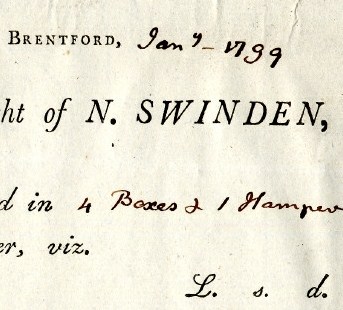
Swinden’s thoughtful and imaginative book demonstrates how to arrange planting for theatrical effect. In an early example of astute marketing, he simplified the implementation of his designs by selling ready-made boxes of seeds for each of them. An invoice shows him exporting specific boxes to Jamaica and there is evidence that London town gardeners were buying his boxes too. His address is given in the book as “near the 8th mile stone at Brentford End”, a short distance beyond what we know as Busch Corner in Isleworth, at the junction of the A310 and the A315 (London Road). The 1786-7 map by Sauthier (Sy_B_XIII_1e) in the Syon archives shows garden grounds on both sides of the London Road and a cluster of buildings along the road near the 8th mile stone.

Swinden’s book was favourably written up in the Monthly Review. Ralph Griffiths of Linden House, Turnham Green, that journal’s proprietor, was a trustee of the Brentford chapel and may have known the Swindens himself.

Earlier, in 1701, “a profligate and wicked youth”, the son of William Badger, was convicted of robbing a gardener called Nathaniel Swinden of a considerable quantity of fruit. Swinden took a whip and “did with great severity lash the boy” whose father soon sent him across the Atlantic to find work in Maryland. William Badger remained furiously angry with Swinden and, frequently drinking too much, behaved “with rancour and malice towards him”. The Anabaptist elders of the Brentford Meeting House intervened to persuade him to forgive Swinden and “carry himself towards him as a neighbour and a Christian”.

Nathaniel Swinden’s home in Old Brentford was registered for non-conformist meetings in 1710 and he was buried in Ealing in 1729. Nathaniel the author may have been the second of four children born to this earlier Nathaniel and his wife Ann. If so he married Jane Franklin in 1753 and had three children, of which one was also called Nathaniel.

However, Francis Swinden, the first Nathaniel’s eldest son, married Mary Piguenit, the daughter of a Huguenot émigré, and had 6 children, the oldest of which was another Nathaniel Swinden (1744-1804). The title page of the Beauties of Flora lists one of the book-shops where it could be purchased as the one in Berkeley Square run by Caesar Danby Piguenit, Mary’s brother, so this Nathaniel is the most likely author and seedsman. Huguenot gardeners in this country pioneered the trade in seeds so Nathaniel’s business may have benefited from this connection.

The will of Mary’s father, Caesar Piguenit, says he lived in Boston Lane, near Brentford Butts, as did Mary and Francis, but these names are not listed in the New Brentford rate books. Nathaniel Swinden appears as a ratepayer in the Butts over many years  – perhaps several generations of Swindens lived together as an extended family?

Comfortable brick houses around the open square of The Butts, built from the 1680s onwards.

Ann Swinden’s will, made shortly before she died in 1756, describes her as a widow living in The Butts. She left property in Southwark and in Red Lion Square, London to Francis and Nathaniel but there is no mention of a garden or nursery. She mentions four children, Nathaniel and Francis and their two married sisters, Ann Bell and the late Mary Bateman. The marriages indicate the family’s status. Caesar Piguenit is “gentleman” in his will while Thomas Bell of Castle Bar House in Ealing, Ann’s husband, was a substantial man of property. The were sufficiently well off to provide for Mr Bateman and two of his children who were described as “lunatics”.

Ann Swinden’s bequests reveal a comfortable home – her son Francis received a silver pint cup, his eldest son a half-pint silver mug, Ann Bell a silver teapot and the three motherless Bateman children a brass hearth and its furniture, a “walnut tree corner cupboard” with the china inside it and “my chints bed quilt” respectively. She also provided mourning gowns for her servants, Mary Giles and Mary Dobbs.

These generous people supported their families and neighbours. The older generation of Swindens had to manage the problems which arose when their son-in-law and two grandchildren turned out to be mentally unstable, making legal provision to manage their property and oversee their care.


References

Nathaniel Swinden, The Beauties of Flora Displayed, Chiswick Local Studies Library (L B Hounslow)

London Metropolitan Archives: Acc/0828/014 Swinden pedigree, and N/C/034/1/1 Brentford Congregational Church records 1693-1867

The National Archives: Ann Swinden’s will: PROB 11/824

The Greenings

The Greenings were established in Brentford End by the early 1700s. Thomas Greening the elder was an innovative plantsman, and his sons followed him into the business. As well as producing plants, they obtained many aristocratic and royal contracts.

Thomas Greening (c1684-1757) and his three sons were all associated with gardens owned by the royal family. At the heart of their business was their nursery at Brentford End, whose management was a shared family undertaking. Thomas and his wife, Ann, were in Isleworth Parish by the early 1700s. There were four sons: John, Thomas, Robert and Richard, and Betsey, whose poor health is mentioned in family letters in the 1730s, was one of several daughters. Most members of the family are buried at Isleworth Parish Church.

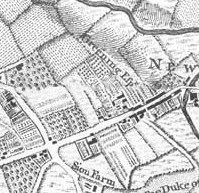
John Rocque identified the Greenings’ house and garden on a small map of the Environs of Syon House which he used to decorate the 1743 prospectus for his ambitious map of London and Environs. Indeed, three Greenings were subscribers to this map. Their house and land were at Brentford End, west of the Brent and actually in Isleworth Parish; they lay on the north side of the road from Brentford to Hounslow, roughly opposite the old footpath from that road into Syon Park. The house was later to become a boys’ boarding school, known as Syon Park House, and survived until the early 1960s.

The Greenings house and garden is labelled near the top of the map

The Rev George Harbin visited Thomas Greening the elder’s garden on 20 August 1719. Harbin’s notes show that Greening was expert in growing dwarf apples and pears in tubs and pots, some of which he had kept this way for 14 years. He also grew peaches, nectarines and espalier apricots which he protected from frost by covering them with a “reed hedge”. Harbin also recorded a large grape vine growing against the house, called the Burlake or White Raisin grape. “The Bunches are extremely large & some of them have weighd above 7 pound”.

Greening and Harbin discussed hyacinths – large white ones with red eyes were 5s or 7s (25p or 35p) a root, the Province Rose, ranunculus (of which Greening grew a sweet-scented striped variety from Turkey), tulips, anemones (the finest included the Battersea Red), cherries, plums, almonds and sorbus. Richard Bradley reported seeing a passion flower in Greening’s garden in Brentford with more than 300 fruits.

Rocque dedicated his 1748 engraving to two Greening brothers.

Queen Caroline invested considerable sums in landscaping the gardens of Richmond Lodge, now part of Kew Gardens, during the 1920s, overseen by Charles Bridgeman and almost certainly largely implemented by Thomas Greening Snr. After Bridgeman died responsibility for their upkeep was given to Thomas Snr, assisted by his son, Robert, from 1738.  Under their care, new features were created – the small wilderness and the sunken feature at the north of the garden, together with the Little Wilderness and the New Mount. During the 1730s the name Greening appears repeatedly in the records of Brentford Ferry, crossing the Thames with laden carts and returning with empty ones.

During the same period it is clear that the business combined the supply of plants and trees from the nursery with the undertaking of landscaping schemes; Thomas Snr worked at Shobdon, at Claremont, took on a commission to work on a major landscaping project at The Gnoll in Neath, Glamorgan and was supplying substantial quantities of fruit trees to Edward Gascoigne at Parlington in Yorkshire.

A set of letters from the two oldest Greening sons – Thomas jnr and Robert – to their father Thomas snr – survive in the National Archives. Robert was sent to manage his father’s farm in Aymstrey, Herefordshire, close to where they had been working on the Shobdon estate of Lord Bateman. The letters include commentary about the management of this farm, with details of the weather, the harvest and wheat prices. Plants and seeds were sent from Brentford to Aymstrey, including turnip seed, some bought in and some supplied from their own Brentford crop. They were also growing elm trees; Thomas Greening snr had been granted a royal patent in the 1720s for the grafting of English elm onto Dutch elm stock to encourage fast growth.

Richard, the youngest son, is mentioned in a letter from Robert to his father dated 26 July 1742: “it is a very great Concern to me that he has so Small a Share of Education . . . for had he been capable I could have recommended him to the Duke of Bolton for a Steward. . . . you may depend  that neither my Br nor me will be wanting in our Brotherly help to him.”  Robert’s letters show him caring for his sister Betsey in Herefordshire but yearning to be allowed to return to work in the Brentford End nursery.

The letters show the family were continually troubled by money problems. They coped to some extent by delaying payments themselves. The letters mention requests for payment: for example, in 1742 Mr Tunstall of Brentford ferry brought a bill which covered the Greenings’ river crossings from 1725 to 1737! At one stage their father has taken the “nurserybook” with him when he is away from home for some time. Thomas the younger writes of the embarrassment he suffers when he goes to seek payment of outstanding invoices only to be shown his father’s receipts for payments that he has failed to record, and the sums he is having to borrow in order to pay for supplies and services to keep the business going. For example, Thomas borrows from Mr Bever, probably Samuel Bever a “kinsman” of his father-in-law, Henry Marsh.  The situation seems to have been made worse by the purchase of a farm in Herefordshire on which they appeared to be losing money.

Their major contracts with the royal family and with aristocratic clients were almost guaranteed to cause difficulty as such people rarely paid quickly, though being known to have a royal contract would have enabled them to obtain credit. Thomas Greening the younger wrote to his father on 9 February 1740 “The book debts are nothing at all except Ld Weymouth’s and the Duke of Marlborough which God knows when I shall receive”. He submitted a petition for payment of invoices for works at Kensington Gardens and St James’s Palace in 1752. A year passed before approval was given for payment of these though the sums involved on these contracts were substantial – £799.13s (£799.65) for Kensington and £354.5s (£354.25) for St James’s Palace.

By 1740 Thomas the elder was paying rates in Turnham Green for a house with a garden and field which he leased from Lord Burlington. This almost certainly lay near the junction of Sutton Lane South and today’s Wellesley Road and was later occupied by the Fromows. In 1746 he married again; his bride was Lucretia Abbott (c1711-1781) and he is described as “widower of Chiswick”. When he made his will two years later he was about to renew his lease and bequeathed the property, after his wife’s death, to his youngest son, Richard.

Thomas the younger (c1710-1757) married Sarah, daughter of Henry Marsh, a gentleman gardener of Hammersmith. Described in his father’s will as being “in a very thriving and prosperous way and stands in no want of anything I can give him”, he had one very large debt towards which his father left him £500. Either he or his father laid out gardens at Kirtlington in Oxfordshire, The Gnoll in Neath, Virginia Water near Windsor and Corsham Court, Wiltshire. In 1751 Thomas the Younger took on Kensington Gardens and St James’s Park, leaving Robert out of the contract and bringing his son into the business instead. He died in February 1757, only a few months before his father.

Thomas and Sarah’s son, Henry Thomas Greening (1730-1809) married Ann Hooper, the daughter of a prosperous Herefordshire lawyer. He appears to have been a gardener too until he inherited a substantial fortune on condition he changed his name to Gott, which he did in 1769. He purchased the Newlands estate in Buckinghamshire in 1770 and built himself a grand house there. Henry Thomas Gott was knighted in 1774.

John, the third son, became the Duke of Newcastle’s head gardener and steward at Claremont; he had worked there with his father as a boy on William Kent’s landscaping schemes. Later he oversaw a formal flower garden and 6 acres of walled garden and greenhouses for high quality fruits. Rocque’s 1738 plan of Claremont has small inset images of buildings on the estate including “Mr Greening’s House”, later known as White Cottage. (In 2012 this was in use as the sixth formers’ centre at the school at Claremont). Between 1758 and 1764 John was the King’s gardener at Hampton Court and was also paid for work at Windsor Great Park.

Robert not only assisted his father at Richmond Gardens but also worked with his brother Thomas there, and on some other contracts. After the brothers had fallen out and gone their separate ways, Robert became Princess Augusta’s head gardener for the pleasure grounds at Kew Gardens (and was also made responsible for her nine cows) from June 1753. He replaced John Dillman who nevertheless continued to be responsible for the 6a kitchen garden, melon ground and orangery there until 1755 when these too became Robert’s responsibility. For this contract Robert was to receive 300gns a year and have the use of 54 acres of farmland. In 1757 his contract was extended to include management of “a sufficient flock of sheep to feed the lawn” but he died in March 1758. His brother John then took on the royal contracts and spent several years sorting out Robert’s estate as executor; he did not receive payments until 1761/2 for some of Robert’s works executed in 1754 – gravelling the path to Goupy’s Chinese arch and overseeing the construction of two other Chinese garden buildings. Robert also produced designs for other estates. Those for the northern gardens at Wimpole Hall in Cambridgeshire survive, with elaborately irregular areas interspersed with formal and symmetrical avenues and vistas.

His wife Ann is described in his will as the daughter of Priscilla Price of Lucton, providing another family connection to Herefordshire. He drafted his will in 1750 when he had recently purchased a property in Isleworth and in Lucton; after Ann’s death these were to pass to his brothers John and Richard. In December 1757 his “dear, dear wife” was dying so he amended his bequests to provide an annuity for his stepmother, Lucretia Greening. He lived only a few months more and died in March 1758.

Richard, the youngest son, seems not to have held significant posts as a gardener. Family letters indicate that he may not have been well educated and refer to sending him money. Thomas the elder made Richard his executor so he must have trusted him. However, bequests from Thomas the elder and from Robert were clearly designed to support Richard, who lived only until 1760. Lucretia, Thomas’ second wife outlived them all, surviving until 1781 when she died aged 70.


References

Michael McGarvie and John H Harvey, Revd George Harbin and his Memoirs of Gardening 1716-1723

Richard Bradley, New Improvements of Planting & Gardening 1731

Ray Desmond, Kew: The History of the Royal Botanic Gardens, Harvill Press, London 1995

Ferry records, Layton Collection; sample pages at www.thamespilot.org.uk

Wills, National Archives: Thomas Greening snr PROB/11/837, Robert Greening PROB/11/837

Family letters, National Archives, C 108/353

Elm tree patent, British Library Eg Ch 8108

Payments for Kensington Gardens and St James’s Park, National Archives   T1.352/2, 3a, 3b, and T1.353/115


Gardeners 1650-1850

presenting the inventive nursery gardeners of Brentford, Chiswick and nearby Middlesex Parishes, 1650-1850

Horticulture was a very significant component of the economy of Middlesex from at least the 17th century and into the 20th. Most local histories remark upon the substantial amount of market gardening which supported London’s growing population at this period but say little of the nursery gardeners.

While both forms of gardening were practised in the area from the 17th century, the nursery gardens evolved to meet changing markets and some became market gardens in their turn in the Victorian period.

Garden historians have tended to concentrate on garden design, mentioning only a few of the major nurseries. The remarkable work of John H Harvey, in Early Gardening Catalogues (1972) and Early Nurserymen (1974), is the exception that proves the rule.

This Nursery Gardeners Archive is designed to give the gardeners back a significant place in the history of the area, especially in the parishes along the Thames. It combines business history, family history and local history in its short essays. In them I make use of a variety of historical sources, including wills, letters, maps and records of property transactions to place the gardeners and their families in local communities. My initial work has concentrated on the Thames-side parishes, especially Chiswick and Brentford which I know best.   Val Bott

This website has been accepted by the UK Web Archive