Henry Woodman & Eleanor Compton

Henry Woodman, his father, his brother and his son were gardeners in Strand on the Green in the 18th century. However, the women of the family were also skilled at running a gardening business, especially Henry’s mother Esther and his long-lived wife, Eleanor.

In 1726 Nicholas Parker left the remainder of his lease on land in Sutton Field, Chiswick, and the stock growing upon it, to “my servant Henry Woodman”, who must have been a high-ranking employee, perhaps the manager of the nursery. Henry Woodman was born in 1698, one of four children of another Henry Woodman, described variously as “husbandman” and as “gardiner”, who had married Esther Durham in 1694. When Henry senior died in July 1701, Esther had three young sons to care for; she gave birth to their daughter, Mary, in September.

Esther lived on until 1784. Two of her sons, Henry and John, were described as gardeners so it is likely that she kept the nursery going. Lady Susanna Lort, who took the Chiswick mansion house which was later known as Heathfield House, employed her to weed her gardens, bequeathing her twenty shillings in her will of 1710. John Harvey thought that Henry Woodman may have inherited his garden from George Masters but both men are listed in the rate-books at the same time, rather than one as successor to the other. From 1727 Woodman’s property was assessed at £45 in the rate books; this was a far higher value than Parker’s Sutton Field alone so must have included the Woodman family nursery too. He was now sufficiently well established to marry Eleanor Compton at St Paul’s Cathedral in 1728, reuniting two of Parker’s bequests.

Henry and Eleanor’s first two children died when only a few days old in 1730 and 1732, but their third child, Henry (1732-1774), worked in partnership with his mother after his father’s death. The daughters were Elizabeth, who married John Kirk, Mary (1741-1770) and Eleanor, who married Thomas Allen in 1768. “Kirk and Allen” were paying land tax on jointly owned properties on Strand on the Green in the 1790s and the 1847 tithe apportionment lists small market gardens then held by Kirk and Allen, so gardening continued with later generations of the family.

Henry Woodman was a subscriber to Philip Miller’s Gardener’s Dictionary of 1731, confirming that he was one of the prominent gardeners of his day. His surviving correspondence shows that between 1729 and 1733 he was supplying substantial quantities of plants and seeds to Henry Ellison of Gateshead Park in County Durham. The letters, mostly to Ellison’s agent, Woolley, are chatty and informative, and advise on planting and protection from frost. Woodman visited Gateshead and sends his best wishes to people he had met there. His letters apologise for delays in finding reliable boats to take the plants up the east coast to Gateshead but usually name each vessel and its master.

In October 1730 he mentions being able to supply “a new sort of pea that beats all I ever saw” and says that he has been “bussey” building a green house “a conveniency I very much wanted”. He also comments on the weather: in 1730 “We have had vast plenty of all sorts of fruit this year and Exceeding Cheap” but in 1731 “the dryness of the summer has made Standard peaches and Nectarines very scarce”.

The invoices list a variety of plants. In October 1729 Woodman sent 26 plums, 30 peaches and nectarines, 34 pears, 20 cherries, 15 apricots, 48 apples on paradise stocks, 108 gooseberries and currants, 6 berberies without stones, 200 raspberries and 400 strawberries. There were also flowering plants, damask roses, honeysuckles, anemones, polyanthus, mixed tulips, anemones, striped lilies, crown imperials, Persian iris, hepaticas, snowdrops and crocus and 50 auriculas.

The following December he fulfilled a substantial order of seeds for nearly forty different kinds of vegetables and herbs, plus 100 asparagus roots, plus carnation layers, double white rocket and another 100 strawberries. Woodman wrote in January 1730 “The Cowcumber & Mellon seed you may depend on to be as good (as) any in England haveing saved it all myselfe”, though later that year he advised Woolley to buy directly (and more cheaply) from Moses James of Lambeth, his usual seedsman.

Late in 1731 he sent trees and hedging plants (200 6 ft-tall elms and 1500 hornbeams at 2 feet) with flowering shrubs and more fruit trees. In early 1732 he wrote to advise on the growing heights of the 1000 flowering shrubs he was supplying to help with the design of the planting, an approach which Nathaniel Swinden of New Brentford was to develop in The Beauties of Flora Displayed in 1778.  He continued to send plants and seeds to the end of 1733.

By then another gardener, Stephen Switzer, had convinced Ellison that Woodman was fixing his prices in league with Woolley. The latter lost his post and after indignant letters from Woodman denying that he would ever do such a thing, Ellison placed the matter in the hands of a lawyer. Harvey considered Woodman’s prices comparable to other contemporary nurserymen but no further letters survive to show how this was resolved. Switzer, however, succeeded in supplanting Woodman at Gateshead Park.

In 1755 the quality of the plants Woodman supplied was endorsed by Thomas Hitt, another distinguished gardener, in his book A Treatise of Fruit-Trees.

“I must own I have received peach-trees and   nectarines from Mr Henry Woodman of Strand on the Green in the county of Middlesex which I planted for the Reverend Mr Ewer of Bottisford near Belvoir Castle; all of them lived and some bore fruit the first year after planting, tho’ they were brought above a hundred miles, and only packed up with straw and matts; they have been planted nine years and are now strong healthy trees.”

Henry Woodman was a respected member of his community and served as a churchwarden in 1739/40. When he died in 1758 he was buried at St Nicholas where the register records that they had fulfilled his request to be buried 12 feet deep. His will left over £1,000 in bank annuities to be managed in trust by his widow, Eleanor, and by William Martin, a maltster and Strand on the Green neighbour.

Of Henry and Eleanor’s five surviving children, four were under 21 when he made his will in June 1755. He added a codicil a year later, changing his bequests after his daughter, Elizabeth, had married and his son William, “who is now lame”, had died. Worried about this lame son, Henry had provided for the legacies left to his other children to go to William should they die before him.

Eleanor Woodman was a strong, resourceful and reliable woman who was deeply involved in the nursery garden for many years more. Eleanor was executor to her brother William and witness to the will of her brother Nicholas. William Compton left a New Brentford freehold and his own house “fronting the Thames” on Strand on the Green, as well as nearby garden ground, to his nephew Henry Woodman Junior, on condition that he continued to work in co-partnership with his mother, but in the event she outlived him.

Eleanor’s own will, proved in 1784, shows her astute financial management. She left £2,000 in 3½% bank stock, twice the £1,000 she had taken over in 1758 as executrix to her husband. She appointed two nephews-in- law as trustees, William Wake and Thomas Hearne, along with Charles Rubery of Sutton Court Farm. (Thomas Hearne senior, another local gardener, had married Eleanor’s sister). She left her Strand on the Green house to her daughter Elizabeth Allen, revealing in passing that she has already moved out “to Chiswick”, with her servant Mary Hoskins. There are bequests to sons in law, grandsons and nieces and nephews, but it appears that apart from Elizabeth all her other children had died.

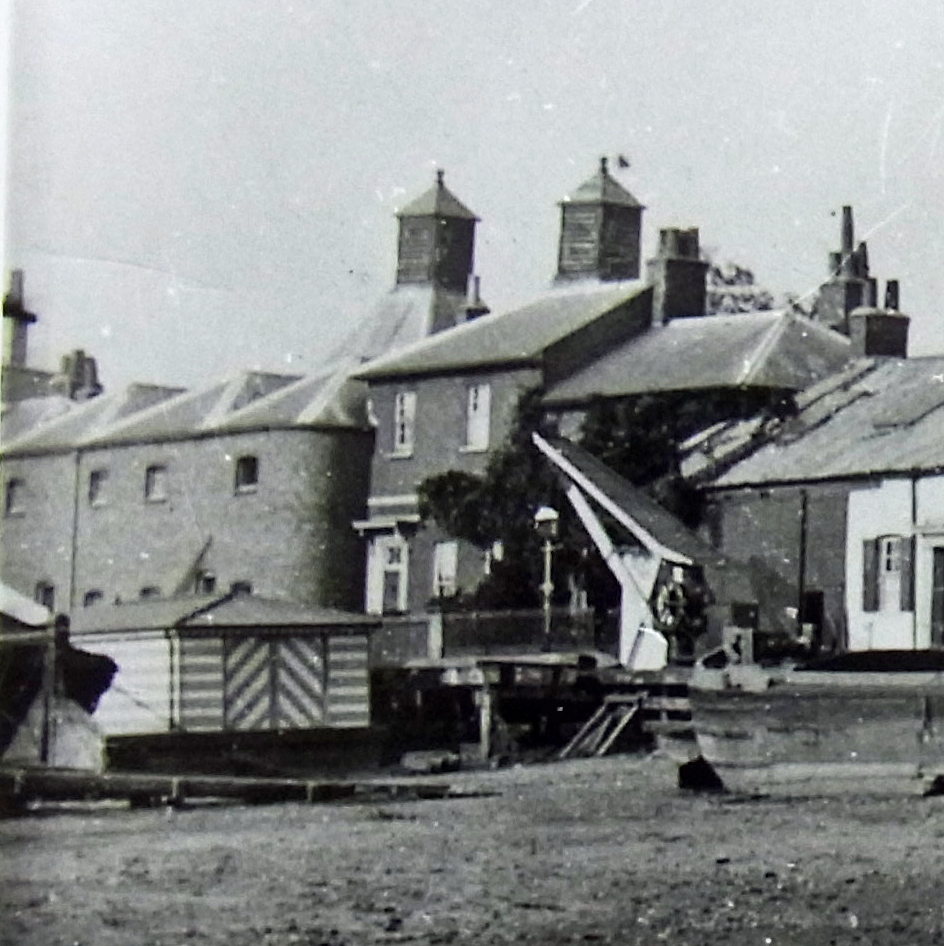
Strand on the Green, about 1875. The Woodman home was next to the malthouse on the left – the houses, workshop and boat yard in the centre stand where Henry’s walled garden once was.

In the early 1970s Kathleen Judges, the Strand on the Green historian, identified the 6-acre plot which descended from Parker via the Comptons to the Woodmans as lying on the north east side of today’s Thames Road, and a further half acre on the Thames as being a plot which was a market garden on the Tithe Map of 1847. Later owned by the Port of London Authority, it lies immediately downstream of Picton House (which she identified as Henry and Eleanor’s most likely home) and was sold by the PLA for a housing development in 1971.

WOODMAN FAMILY TREE

Nicholas Parker

Nicholas Parker was a wealthy gardener who lived on Strand on the Green. After his death in 1726, his bequests to Henry Woodman and his future wife Eleanor Compton, and to other members of the Compton family, ensured the continuation of the garden grounds in skilled hands.

Nicholas Parker

The accounts kept by the Earl of Fauconberg’s steward, Arthur Palmer, record substantial expenditure on the Earl’s new gardens at Sutton Court, Chiswick between 1685 and 1700. The name of Nicholas Parker recurs regularly in Palmer’s account book. Parker supplied plants, sometimes in large quantities, for the Sutton Court garden. Almost all of the payments made to Nicholas Parker or Mr Parker are for the supply of “trees” with only one entry for “plants”. A few entries are more specific, listing “ew”, 300 hornbeams and 38 phillireas, and in 1685 alone Mr Parker was paid the substantial sum of £17 for fruit trees. Separately, “Goodman Parker” appears against payments of £19.2s and £50 for carpentry, with a further £17 for “digging and wharfing a new pond”.  It is probable that Goodman Parker was Nicholas Senior, father to the gardener.

So far it has not been possible to identify exactly where all of the Parkers’ properties lay.  Nicholas Parker Senior appears in the rate books on Strand on the Green from around 1660; he signed his name as a member of the vestry in 1675 and died in December 1714. Nicholas Parker Junior was not rated identifiably by that name until about 1690. In 1699 he served as churchwarden and in 1709 made a donation of £1 towards work on the north aisle of the parish church. By 1719 he is paying rates on property worth £38 and land in Sutton Field worth £16, almost certainly having taken over land which his father occupied.

Given the quantities of trees supplied to Fauconberg, Nicholas Parker was already a substantial nurseryman by the 1680s, though he does not appear in Harvey’s very comprehensive book, Early Nurserymen. Fortunately a will of June 1725 made by Nicholas Parker of Strand on the Green, “Gardiner”, has survived. In it he requested that he should be buried near his late father at St Nicholas Church, Chiswick.

Though no reference is made in the will to a wife, he seems to have been married twice. His first wife, Elizabeth, was buried in 1688 at St Nicholas; on 11 December 1693 the marriage is recorded between Nicholas Parker, gent, widower, and Mrs Jane Goodwin, widow, by Canterbury licence.

From the lists of Chiswick burials, she may have been the widow of Henry Goodwin, buried in linen in 1687/8, or of another Henry Goodwin buried in 1690. The wealthiest of the Goodwins was living at Sutton Court in 1719. And there were Goodwins who were gardeners, who owned land north of Chiswick High Road, near today’s Chiswick roundabout. There were  Brentford Goodwins as well, including a basket-maker.

In 1709 Nicholas Parker Junior is named by George Warner of Turnham Green as one of two executors “which I esteem as my loving friends”. Parker’s social status as a gentleman is further confirmed by his own “good friends” mentioned in the will. He leaves a guinea each for mourning rings for Mr Thomas and Mr George Barker and appoints another, Thomas Mawson, as executor. The Barkers had owned The Grove estate in Chiswick since the middle ages and its land adjoined Vernon Cottage. Mawson had property on the Strand and owned the brewery which was the predecessor of today’s Griffin Brewery. His family was also comfortably off, and one of his brothers was Bishop of Chichester.

Parker’s bequests reveal him to be a man of property with copyhold houses and land in Turnham Green, Little Sutton and Strand on the Green, held of the manor of Sutton Court, and two freeholds in Catherine Wheel Yard, New Brentford. The freeholds secured the right to vote, and a Nicholas Parker is listed in the 1710 Middlesex Poll Book. At this date Nicholas Parker Senior was still alive so these properties may have come to our gardener as a bequest from his father. The will also includes two properties at Strand on the Green, one with six acres and the other with half an acre of land which Parker occupied himself.

William Compton, Parker’s “kinsman” and one of his executors, inherited most of the property, including a house with five and a half acres of gardens at the downstream end of Strand on the Green, then let to Joseph Miller, the comic actor. Miller leased this house, later named Vernon Cottage,  from 1686 to his death in 1738.  And when Nicholas Compton died in 1760, describing himself as gardener in his will, he bequeathed a house with five and a half acres of gardens which he himself occupied, confirming that this was the house he had inherited. Vernon Cottage is clearly labelled on Leigh’s 1831 Panorama of the Thames, just downstream of the Strand, with a walled garden and at least one glasshouse. William Compton took on responsibility for his brother Nicholas’ five daughters and later left garden grounds to the oldest of them in his own will.

Along with £5 for the poor of Strand on the Green, Parker’s will provided  annuities for various relatives as well as bequests of £50, £100 or £200 to a number of friends and relatives:  Elizabeth Parker “now living with me”, Mary and Ellen Parker, William Goodwin of Shepperton, Thomas Goodwin of Laleham, Katharine and Eleanor Compton of Turnham Green. Parker often uses the word “kinsman” to describe these heirs, suggesting that they may have been his wives’ relations rather than his blood relatives. William Compton’s will reveals that Katharine and Eleanor were the sisters of himself and Nicholas Compton.

The Masters family

Several generations of the Masters family, including women gardeners, cultivated garden grounds in Strand on the Green and London Stile in Chiswick and Acton parishes in the 17th and 18th centuries.

George Masters of Strand on the Green died in March 1734 and in May a public notary assisted his widowed sister, Rebecca Clements, to prepare an inventory of his property. The document lists his furnishings and utensils, in seven rooms and a yard, followed by his nursery stock, tools and equipment. While the house was relatively sparsely furnished, his gardens were bursting with plants.

In the “seed rooms and other lofts” were old clothing, linen and lumber but no seeds, though bushells of peas and beans were listed elsewhere. The detail of the inventory is valuable in showing the range of plants Masters grew, mixing trees, shrubs and hedging plants with orchard trees and plants for the flower garden.

John Harvey found Masters’ name as one of the gardeners who prepared a similar inventory following the death of William Cox of Kew in 1722. Batty Langley, the son of a Twickenham gardener, wrote in New Principles of Gardening in 1728 that Cox was an improver of early peas, a variety “known by the name of Master’s Hots, first raised and improved by an ingenious Gardener and Nursery Man of that name now living in Strand on the Green near Old Brentford”.

Peas were popular in the early 18th century and Masters’ inventory lists six bushells of Hotspur Peas and a further bushell of dwarf peas at 5 shillings a bushell, as well as 12 bushells of garden beans at 2 shillings a bushell, relatively modest quantities. The gardens were not planted with peas for seed when he died. In comparison, John Brooks, a neighbour, bequeathed to his son by his July 1723 will “seven cows & two heifers, seven hoggs, my seed peases worth forty pounds and his mothers books”. At 1734 prices this represents between 135 and 160 bushells of peas.

Chiswick Local Studies Collection

The inventory describes eleven plots, five on leases and one of these in Acton. More research is needed to confirm their locations but other evidence suggests that most were at London Stile, between today’s Kew Bridge and the High Road junction with Wellesley Road. These garden plots lay among many others in the triangle of rising ground between the riverside village of Strand on the Green on the west, the  road to the west on north and Sutton Lane/Fauconberg Road and Grove Park Terrace to the south east (all London W4 today).

On his 1746 map of London & Environs Rocque shows the gardens with parallel rows of planting, sometimes in squares, and enclosed within walls or hedges to shelter them from the winds which whip across the flat land beside the river. The area was well placed for road and river transport and near to the Brentford & Kew Ferries.

In the “Garden next the Road Walled Round with Bricks” were flowers – six beds of anemones, 5,000 ranunculus, 44 cyclamen, 20 scarlet lichen, 24 double lady smocks, 12 peach-coloured hepaticas at a penny each and four blue at 6 pence each, along with 1,000 small yews and a few large hollies. In “the Great Garden Ground” were 200 striped lilies at three pence each, four thousand jonquils, 1500 Persian Iris at 2 shillings a hundred, 4 beds of double peonies and 600 fraxaneias.

The next three plots have trees, shrubs and hedging plants in large quantities. There were 10,000 quick (small cuttings of hawthorn or hazel) at 3 shillings a thousand, 600 “hedge yews at 3 foot high” at 10 shillings a hundred, 800 small seedling yews, standard elms, 24 roses at a penny each and 100 “lealocks” (lilacs) worth 15 shillings. In addition there were fruit trees: 200 plum stocks, 500 codling stocks and “pairs” (pears), 200 gooseberry plants, 100 redcurrants and 25 mulberry trees.

The “Upper Quarter next the Wall” housed some plants, the stock of seed peas and beans, and a great deal of equipment.  Besides 600 horse chestnuts and 100 English chestnuts together worth £1 and 2,000 honeysuckles worth £5, there were plots of roses, standard elms, and “a parcel of small Orange Stocks in Potts and the Potts” worth 15 shillings.

The equipment included 11 lights for cucumber frames containing about 150 feet of glass at 3d a foot, 48 glasses for melons at 8d a glass, about a thousand paving bricks, 236 sieves and 22 half sieves (market baskets usually in bushell and half-bushell sizes), 16 maunds (baskets with handles), three barges (barrows without wheels), two hand-barrows, four garden ladders, a pair of steps, a harrow and a roller, a drill plough, a swing plough, 100 small garden pots, a water barrow and tub and four watering pots. All of the gardeners must have used large numbers of flower pots and these, together with other useful clay items like weights for fishermen’s nets, were probably made only yards upstream at Mr Trimmer’s brick tile works, or at the pottery in Brentford.

Survey of Ealing Parish 1777
Detail from A Survey of Ealing Parish of 1777

The plot of land in Acton, leased from William Goodwin, held 800 elms at 10 shillings a hundred, 2,000 hornbeams at £5 a thousand and 500 beeches at 10 shillings a hundred. Though it lay in a neighbouring parish, Goodwin’s land was only a short distance eastwards near Turnham Green, on the opposite side of the road from the other plots held by Masters at London Stile, as the map shows.

On 2 acres at Strand on the Green, leased from John Pennar, were 100 pear trees, 25 double flowering whitethorn, 24 single flowering pomegranates, 150 Spanish chestnuts, 100 gooseberry plants, 1,700 small bays, four thousand yews 4 feet high worth £20, 200 grafted plum trees and plots of elm and yew trees. John Pennar or Pinner was a local carpenter who had been admitted to 3 acres of land and five cottages in 1707. In May 1734, after Masters’ death, Pennar surrendered them in the manor court to another gardener, William Compton, one of the heirs of Nicholas Parker.

As George Masters seems not to have left a will we have no details of family bequests or friends who were witnesses. He would certainly have needed labour in his gardens but we have no information about his workforce. However, the family can be reconstructed from other sources. The George who died in 1734 was the son and grandson of men of the same name. The burial of his mother Martha, in 1702, appears in the parish register with a note that she was the wife of George Masters, gardener, confirming that at least two generations were engaged in the gardening trade.

In 1685/6 a George Masters of Chiswick took an 8-year lease on the gardens of Holland House in Kensington, described as the Great Garden and the Kitchen Garden, from Viscount Dunkellin and the Countess of Warwick. He was to cultivate and maintain these gardens, and could house a “servant” in one of the lodges, but he must also allow the family of the aristocratic owners to continue to enjoy the gardens.

It is likely that this George Masters was “our” George’s father, who died in 1707. He was listed in the rate books at the fourth property from the south west end of Strand on the Green in the 1680s, with his father at London Stile from the 1670s. The parish rate books show “our” George signing his name as a vestry member in 1719. He took on his father’s property with the garden ground at Strand on the Green still valued at £24, while his brother Richard was listed 30th from the south west with a house worth £3. Their cousin, Thomas Masters, was at Little Sutton, with property worth £25, where another plot worth £30 was held by Masters and West. Given the huge difference in valuation, it is possible that Richard is rated only for a house and might have worked with George on the family gardens.

Rebecca Clements, born in 1681, married Richard Clements, from a large Isleworth gardening family, in 1708; she was widowed by March 1734 when she prepared her brother’s inventory. August 1734 saw two weddings – George’s daughter, Elizabeth, married Philip Clements while Rebecca married Rice Lewis, gardener to Lord Burlington at Chiswick House. (J H Harvey records that Lewis was one of the prominent gardeners who subscribed to Philip Miller’s Gardener’s Dictionary of 1731.) Rebecca made her will in 1735, describing herself as a gardener. In it she dealt with her own estate from the settlement made at her marriage to Lewis. Her sister Catherine’s husband, Thomas Couchman, a distiller with property in the City of London and on Strand on the Green, was a trustee of the settlement.

When Luke Wetten, the royal confectioner, acquired a house nearby with 6 acres of orchard and gardens in 1772, and a further 4.5 acres of adjoining land in 1774, both properties were said to have been “heretofore occupied”  by George Masters. His relationship to “our” George is not yet clear. The court rolls record that the same property was let to Mr Zoffany, the artist, during 1764-1772. This was probably the adjoining Sydney House rather than London Stile House, but a Masters clearly worked most of the garden ground there.

MASTERS FAMILY TREE